🇵🇦 Panama Exits the EU Tax Blacklist: What It Means for Banking, Investors and Residency
Panama has officially exited the EU tax blacklist after more than six years. Discover what this means for international banking, investors and the country's reputation, plus the residency opportunities available in 2026, including a special permanent residency pathway for Italian citizens.
JURIS Editorial
After more than six years, Panama is officially off the European Union's tax blacklist. A significant development that could strengthen the country's international reputation, improve investor confidence and create new opportunities for individuals considering Panama as a destination for residency, business and international investment.
On October 9, 2026, the Council of the European Union removed Panama from Annex I of its list of non-cooperative jurisdictions for tax purposes, transferring the country to Annex II, commonly referred to as the EU tax grey list.
But what does this actually mean, particularly for international banking, investors and those considering relocating to Panama?
What Is the EU Tax Blacklist?
In simple terms, the EU tax blacklist identifies countries that do not meet certain international standards concerning tax transparency, fair taxation and cooperation with other jurisdictions.
Being blacklisted does not mean that a country is illegal or that investing there is prohibited.
However, it can have consequences.
Countries appearing on the blacklist may face:
- Greater scrutiny of international financial transactions.
- Additional tax reporting requirements and defensive measures applied by EU member states.
- Restrictions involving certain European funding programmes.
- Reputational challenges when attracting foreign investors and international businesses.
For countries seeking to position themselves as international financial centres, remaining on the blacklist can be a significant disadvantage.
Why Does This Matter for International Banking?
One of the most interesting aspects of Panama's removal concerns its relationship with international financial institutions.
Banks assess several factors when opening accounts or processing cross-border transactions, including the jurisdiction involved, the origin of funds, the client's business activities and potential compliance risks.
When a country appears on an international tax blacklist, financial institutions may incorporate that designation into their internal risk assessments.
This can result in additional documentation, enhanced due diligence and, in some cases, more complicated banking relationships.
Panama's removal from the EU blacklist could therefore contribute to improving how the country is perceived by international banks and financial institutions.
However, this does not mean that opening a bank account in Panama or transferring funds internationally will automatically become easier.
Banks will continue to apply Know Your Customer (KYC), Anti-Money Laundering (AML) and source-of-funds verification procedures.
It is also important to distinguish the EU tax blacklist from the Financial Action Task Force (FATF) grey list, which focuses on money laundering and terrorist financing risks.
Panama was already removed from FATF's grey list in October 2023.
The latest EU decision represents another step in the country's efforts to strengthen its international financial standing.
Why Was Panama Removed?
According to the Council of the European Union, the decision follows reforms introduced by Panama concerning its foreign-source income exemption regime.
The country has also been granted a new review by the OECD Global Forum regarding compliance with international standards for the exchange of tax information on request.
While that review remains pending, Panama will stay in Annex II.
This distinction matters.
Panama is no longer classified by the EU as a non-cooperative jurisdiction for tax purposes, but it remains subject to monitoring and outstanding commitments.
The removal represents meaningful progress rather than the conclusion of all international compliance assessments.
Could Panama Become More Attractive to International Investors?
Panama already offers several characteristics that appeal to internationally mobile entrepreneurs, investors and families.
Its economy uses the US dollar, the country has an established banking and financial services sector, and its strategic position connects North and South America.
Another important consideration is its territorial tax system. Under Panama's tax framework, income genuinely classified as foreign-source income is generally outside the scope of Panamanian income taxation, subject to the applicable rules and exceptions.
This can be attractive for internationally structured businesses and individuals receiving qualifying income from overseas.
However, operating an international business from Panama does not automatically mean that all the income generated is foreign-source or exempt from taxation.
Tax residency, immigration residency and the source of income must always be analysed separately.
The improvement in Panama's international reputation could make the jurisdiction worth revisiting for individuals evaluating long-term residency and investment strategies.
How to Obtain Residency in Panama in 2026
Beyond its financial and tax characteristics, Panama offers several residency options for foreign nationals.
Depending on nationality, professional circumstances and available capital, applicants may qualify through investment, employment, retirement or specific international agreements.
1. 🇮🇹 Italian Citizens: A Special Residency Agreement
One of Panama's lesser-known opportunities is available specifically to Italian citizens.
Under the Treaty of Friendship, Commerce and Navigation between Italy and Panama, incorporated into Panamanian law through Law No. 15 of 1966, Italian nationals may apply directly for permanent residency.
Unlike many investment-based immigration programmes, this route does not impose a fixed minimum real estate investment of USD 200,000 or USD 300,000.
Applicants must, however, demonstrate an eligible economic or professional basis for establishing themselves in Panama, such as a properly documented business activity or qualifying employment relationship.
Standard immigration documentation is also required, including identification, police clearance, a medical certificate and evidence of financial solvency.
The programme offers a particularly interesting possibility for Italian entrepreneurs, professionals and families looking to establish a genuine long-term presence in Latin America.
Any employment or regulated professional activity remains subject to the applicable Panamanian rules.
2. Qualified Investor Residency
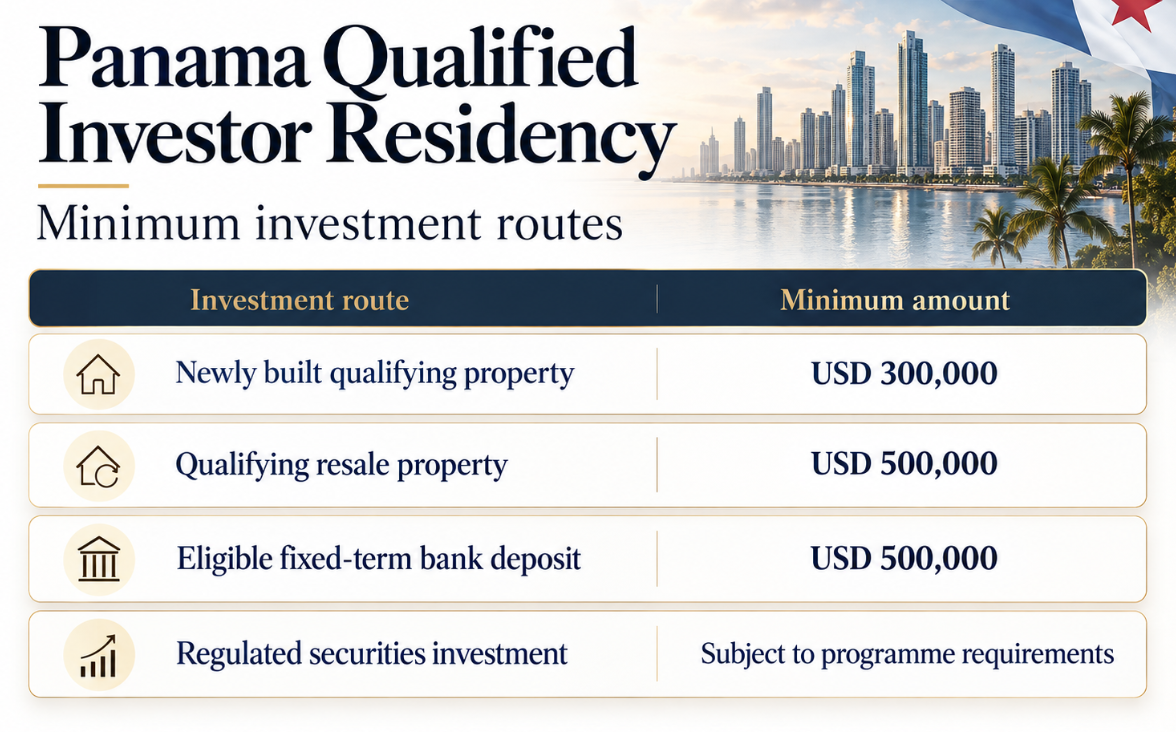
Panama also offers a direct permanent residency programme for qualifying investors.
Following regulatory changes introduced in September 2026, eligible investment routes include:
Applicants must comply with the applicable conditions concerning investment structure, source of funds, ownership and maintenance periods.
For investors considering Latin American real estate or portfolio diversification, this can represent an alternative to traditional temporary residency programmes.
3. Friendly Nations Visa
Panama maintains a separate residency programme for nationals of designated countries with recognised friendly relations.
Depending on the applicant's circumstances, qualifying routes may include:
- Real estate investment from USD 200,000.
- A qualifying fixed-term bank deposit from USD 200,000.
- Eligible employment in Panama.
The process generally involves an initial two-year provisional residency period, followed by an application for permanent residency.
Italian citizens should note that Italy is not included in the Friendly Nations country list. However, they benefit from the separate residency procedure established under the bilateral Italy-Panama treaty.
4. Pensionado Residency
Panama is also known for its permanent residency programme for retirees.
The Pensionado programme generally requires evidence of a qualifying lifetime pension of at least USD 1,000 per month, subject to the applicable rules and adjustments.
For retirees seeking a warmer climate, international connectivity and a different lifestyle, Panama remains a destination worth considering.
Does Permanent Residency Mean Tax Residency?
Not necessarily.
Obtaining a permanent residence permit in Panama does not automatically establish Panamanian tax residency or terminate tax residency elsewhere.
For example, an Italian citizen relocating to Panama must consider the applicable Italian tax residence tests, the individual's actual circumstances and any relevant reporting obligations.
Equally, having a Panamanian residence permit does not guarantee approval for a bank account.
For internationally mobile individuals, effective planning requires a coordinated approach involving immigration, taxation, banking and personal circumstances.
JURIS Global Perspective
Panama's removal from the EU tax blacklist is undoubtedly a positive development for the country's international positioning.
It does not eliminate financial compliance requirements, guarantee easier banking or automatically create tax advantages.
Nevertheless, it removes an important reputational obstacle at a time when more entrepreneurs, investors and internationally mobile families are reassessing where to live, invest and structure their international affairs.
Panama already offers an established financial sector, territorial taxation and several residency pathways, including a particularly interesting bilateral arrangement for Italian nationals.
The latest EU decision adds another consideration to that equation.
For those exploring a second residency, geographical diversification or a long-term presence in Latin America, Panama deserves renewed attention.
Your next step
Speak to an adviser
Tell us what you need. The JURIS team will review your enquiry and help you find the right support.