CBI 2.0: Citizenship tied to specific public projects, not the Treasury
Could citizenship contributions fund specific hospitals, schools and public infrastructure? CBI 2.0: a model linking each contribution to an independently audited public project, with limited places and individual assessment. Using Argentina as a case study, he explores how it could work and the legal and international challenges it would still face.
JURIS Editorial
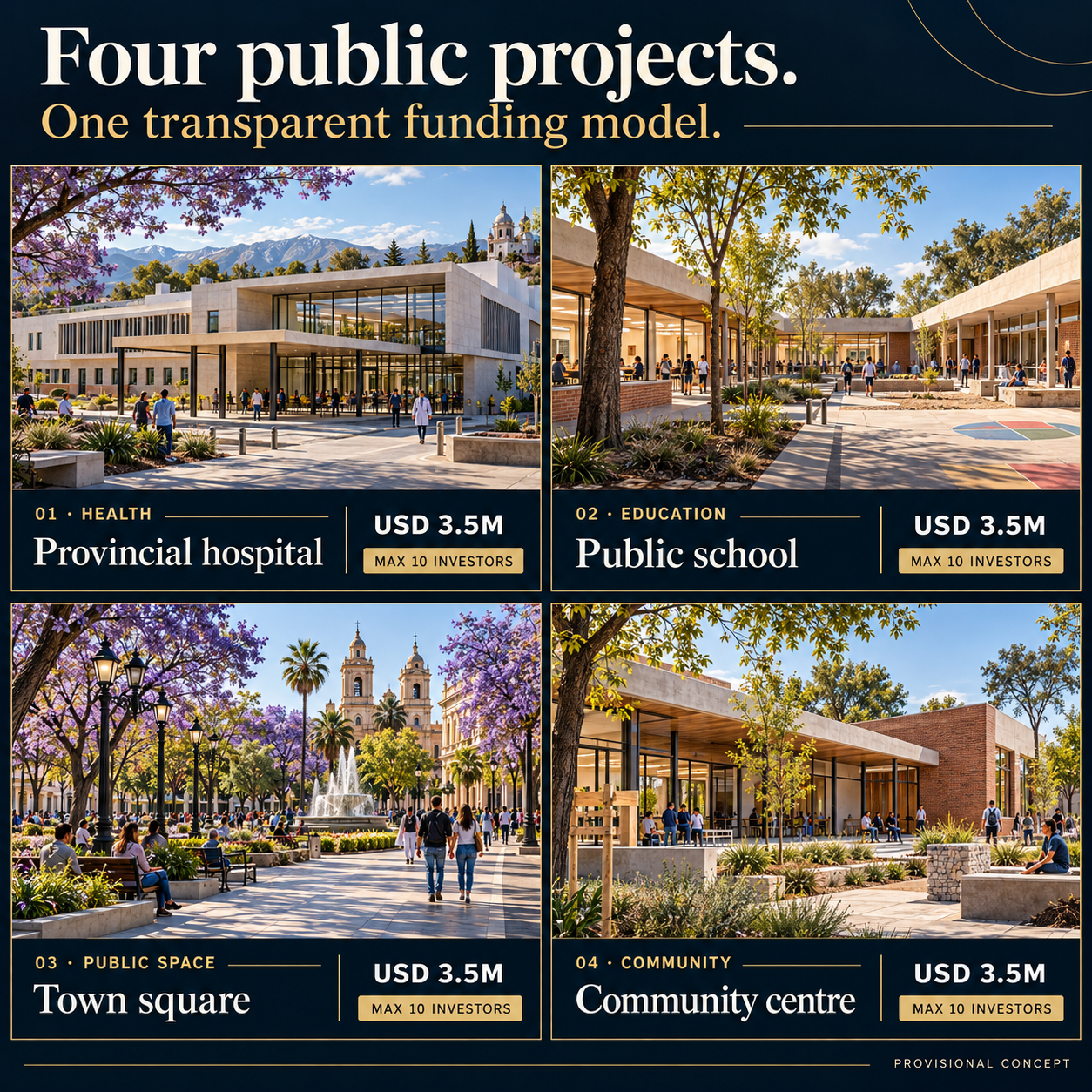
Imagine a provincial hospital in Argentina that needs USD 7 million to be built and equipped. Instead of issuing a general appeal for capital, the government publishes the project: its cost, location, the population it will serve, the organisation responsible for delivery, the timetable and the independent auditor. At the same time, it opens 20 places. Each requires a non-refundable contribution of USD 350,000, plus due diligence and processing fees. Once 20 applicants have been approved and funding is complete, the window closes. The next opportunity depends on the next approved project, within a national cap of 1,000 places a year.
This example is hypothetical, as is everything that follows: it is a public policy proposal, not a programme currently open to applications. In my previous articles on Argentina, I examined the commercial opportunity, the legal issues surrounding DNU 366/2025 and the Schengen risk. Here, I want to be constructive. I have worked in citizenship and residence by investment since 2012, and I believe this is the direction the sector should take. I call it CBI 2.0 or, more precisely, Citizenship by National Contribution.
A new name only matters if the structure changes
Most CBI programmes operate on a simple exchange: a predetermined amount goes into a fund or an approved asset and, following due diligence, a passport is issued. The Argentine model announced by the Ministry of Economy in Paris on 2 October 2026 follows the same logic: a non-refundable contribution of USD 350,000 to the national Treasury or the purchase of a USD 800,000 government bond, with proceeds intended to strengthen the country’s fiscal position. Applications are expected from the fourth quarter, but at the time of writing, these terms remain a ministerial announcement, not published regulations.
There is nothing inherently wrong with a contribution to the Treasury. But money paid into general revenue is invisible to the public, and that invisibility is precisely what makes CBI politically vulnerable everywhere. I deliberately use the same USD 350,000 announced by the government: the question is not how much, but where it goes. My proposal changes three things. The money is tied to a specific, publicly disclosed project. The number of places is determined by each project, within a national cap of 1,000 a year. And the grant of citizenship is conceived as recognition of an individual contribution, assessed on a case-by-case basis.
The current text of Law 346, as amended by DNU 366/2025, already points in this direction. Article 2 bis allows the Ministry of Economy to define which investments qualify as “relevant” and expressly authorises it to establish specific investment projects for that purpose. In other words, a project-based route could fit within the programme the government is already launching, on the same legal foundation, without introducing any legal risk that the Treasury route does not already carry. The real question is whether that shared foundation is sound.
The legal foundation is the difficult part
At present, it is not. The investment route was introduced through a necessity and urgency decree, and in June 2026, two federal appellate courts ruled against the decree’s citizenship provisions. Chamber III of the Federal Civil and Commercial Court of Appeals declared them unconstitutional in the Volosh case. On 30 June, the National Electoral Court declared DNU 366/2025 null and void in the Yang case, holding that citizenship is linked to political rights, a subject the Constitution places beyond the scope of executive decrees. The government announced an appeal to the Supreme Court and, as far as I have been able to establish, the Court has not yet ruled.
I therefore see two stages. In the short term, a project-based route under Article 2 bis is no weaker than the Treasury route, and it is stronger in public debate because every dollar has a visible destination. It does not, however, remedy the formal objection to the decree. In the long term, neither route is secure until Congress intervenes. Article 75, paragraph 12, of the Constitution gives Congress the power to enact general laws on naturalisation, and a model intended to last should be established by legislation, not by decree.
Then there is residence. Article 20 states that foreign nationals may obtain naturalisation after two years of continuous residence, but that the authorities may shorten this period for applicants who claim and prove services rendered to the Republic. Shortening does not mean abolishing, and no one can say with certainty that the Constitution permits a residence requirement of zero. History helps, but it does not settle the issue.
The 1869 text of Law 346 granted naturalisation “regardless of the length of residence” to foreigners who had established a new industry or built railways, and Decree 3213/1984 extended this logic to any action representing moral or material progress for the Republic. That list was replaced in 2025, and I am not presenting it as a route available today. It does, however, show that Argentine law has long regarded contributions to national development as a form of service. New legislation would give that tradition a modern framework.
Payment or merit: the tension a name cannot resolve
If paying USD 350,000 creates an automatic entitlement to a passport, the model remains transactional, whatever it is called. If citizenship recognises individual merit, approval cannot be marketed as guaranteed.
I do not claim to resolve this tension. The substance of the programme can reduce it. Assessment must be individual: the applicant’s profile, conduct and connection to the project must be considered, not just the bank transfer. Decisions must be reasoned, open to appeal and entrusted to a body designated by law.
The contribution must be meaningful in relation to a specific public outcome, rather than simply a payment into a pooled fund. And applicants should undertake a personal commitment, such as a role on the project’s advisory committee or participation at key milestones. None of this makes the system purely merit-based. It does, however, make the element of merit credible enough to defend in court and before the public.
Choosing among applicants without an auction
My commercial assumption is that demand for well-designed places would exceed supply. It is an assumption, not an established fact, and the model must work in either case. What it must never become is a bidding war.
The contribution per place is fixed and published. Applicants must first pass screening covering identity, wealth, source of funds, criminal history and reputation, with the involvement of the relevant government agencies. Those who pass are ranked according to public, non-financial criteria. Every decision is reasoned. Applicants who are not selected retain their position for the next project, and offering more money never moves anyone up the list.
Where the funds go, and what happens if things go wrong
The contribution should be paid into a dedicated trust or escrow account restricted to the project. Before completion, meaning before the applicant has been approved and the project is fully funded, the refund rules must be clear: rejected applicants receive their money back, less due diligence fees. After that point, the contribution is non-refundable. It is not risk capital, a loan or an investment. There is no financial return, and anyone presenting it as such should be excluded from the programme.
Citizenship should not have to wait until the hospital is finished. It should follow approval, completion of the contribution and the release of funds for the project. If the works are subsequently delayed or fail, applicants who have fulfilled their obligations in good faith must be protected: a failure by the state or a contractor is not fraud by the applicant and should never justify revocation.
Instead, it should trigger contractor liability, performance guarantees, an independent audit, for example by the Auditoría General de la Nación, and the reallocation of funds to an equivalent project already approved. Revocation should be reserved solely for fraud by the applicant. Every project should publish regular progress and expenditure reports, and no official, agent or contractor involved in a project should be able to influence who receives its places.
Families require explicit rules, not assumptions: whether spouses and children are included, what contribution applies and whether they count towards the project’s places. I would set the cap at 1,000 main applicants a year, which, at USD 350,000 each, could channel up to USD 350 million annually into named public works, with a separate, publicly disclosed limit for family members, both established by Congress.
Six months, no relocation
Two elements are essential. Citizenship and passports for approved applicants within a maximum of six months of submitting a complete application, and no requirement to relocate to Argentina, apart from a brief visit for identity verification, an interview and the oath.
The six-month period is a design target, not something guaranteed by current legislation. It requires legislation, procedures and staff, including within the federal courts if naturalisation remains under their jurisdiction. The clock should pause when the authorities request information, and the expiry of the deadline must never result in automatic approval or lighter checks.
The European question
Visa-free access to the Schengen area is an important part of the Argentine passport’s value, and it is at risk. Regulation (EU) 2025/2441 allows the Union to suspend visa exemptions for a country operating an investor citizenship programme that grants citizenship in exchange for predetermined payments or investments without a genuine link.
A fixed contribution of USD 350,000 per place is a predetermined payment. A different name, a smaller quota and a philanthropic purpose are not, on their own, enough to exclude a programme from this definition, and financing a hospital does not automatically create a genuine link.
Three questions must remain separate: validity under Argentine law, public benefit for Argentina and international acceptance. A model may satisfy the first two and fail the third. The forms of involvement described above help, but they reduce the risk without eliminating it. Early, transparent dialogue with Brussels would be wiser than launching first and explaining afterwards.
Why I still believe in it
This model answers the question critics always ask: what did the country actually gain? A hospital with a budget line and an audit trail is a better answer than an entry in the Treasury’s accounts. Scarcity tied to real projects introduces a discipline that open-ended programmes lack.
The legal issues remain unresolved, but this model introduces no risk that the announced programme does not already carry. To make it durable, Argentina would need an Act of Congress defining eligible contributions, the authority responsible for assessment and the procedure; clarification from the Supreme Court on the pending litigation; a public portfolio of independently audited projects; the resources needed to make the six-month target realistic; and a pilot phase involving a small number of projects before opening all 1,000 places. It is a demanding list. In my view, it is also the most credible path towards a generation of citizenship programmes worth defending.
Disclaimer:This article presents the author’s personal views and a hypothetical public policy proposal. It does not describe a programme currently open to applications or constitute legal, tax, investment or immigration advice, an offer of services, or a government-endorsed initiative. Proposed contributions, quotas and timelines are illustrative, not official terms. References to announced measures and ongoing litigation reflect information available at the time of writing and may change. No guarantee is made regarding implementation, eligibility, citizenship approval or continued visa-free access. Readers should verify current requirements with the relevant authorities and seek independent professional advice before acting.
Your next step
Speak to an adviser
Tell us what you need. The JURIS team will review your enquiry and help you find the right support.