🇭🇺 Hungary's 9% Corporate Tax: Why Banking, Business Substance and Residency Matter More Than Incorporation
Hungary's 9% corporate tax rate makes it an attractive destination for international entrepreneurs, but incorporation alone is not enough. Discover why banking access, economic substance, effective management and residency planning are essential to building a compliant and sustainable business structure in the European Union.
JURIS Editorial
By dr Robert Kaszó, LL.M. JURIS Hungary | International Business & Global Mobility
Hungary continues to attract international entrepreneurs with one of Europe's most competitive corporate tax regimes.
With a 9% corporate income tax rate, access to the European Union's single market and several residency options for non-EU nationals, the country offers interesting opportunities for international business structuring.
But establishing a Hungarian company is only the beginning.
For foreign investors, the real challenge is ensuring that the company can operate effectively, maintain appropriate banking relationships and comply with both Hungarian and international tax requirements.
A successful international structure requires more than a certificate of incorporation.
1. Hungary's Corporate Tax Advantage
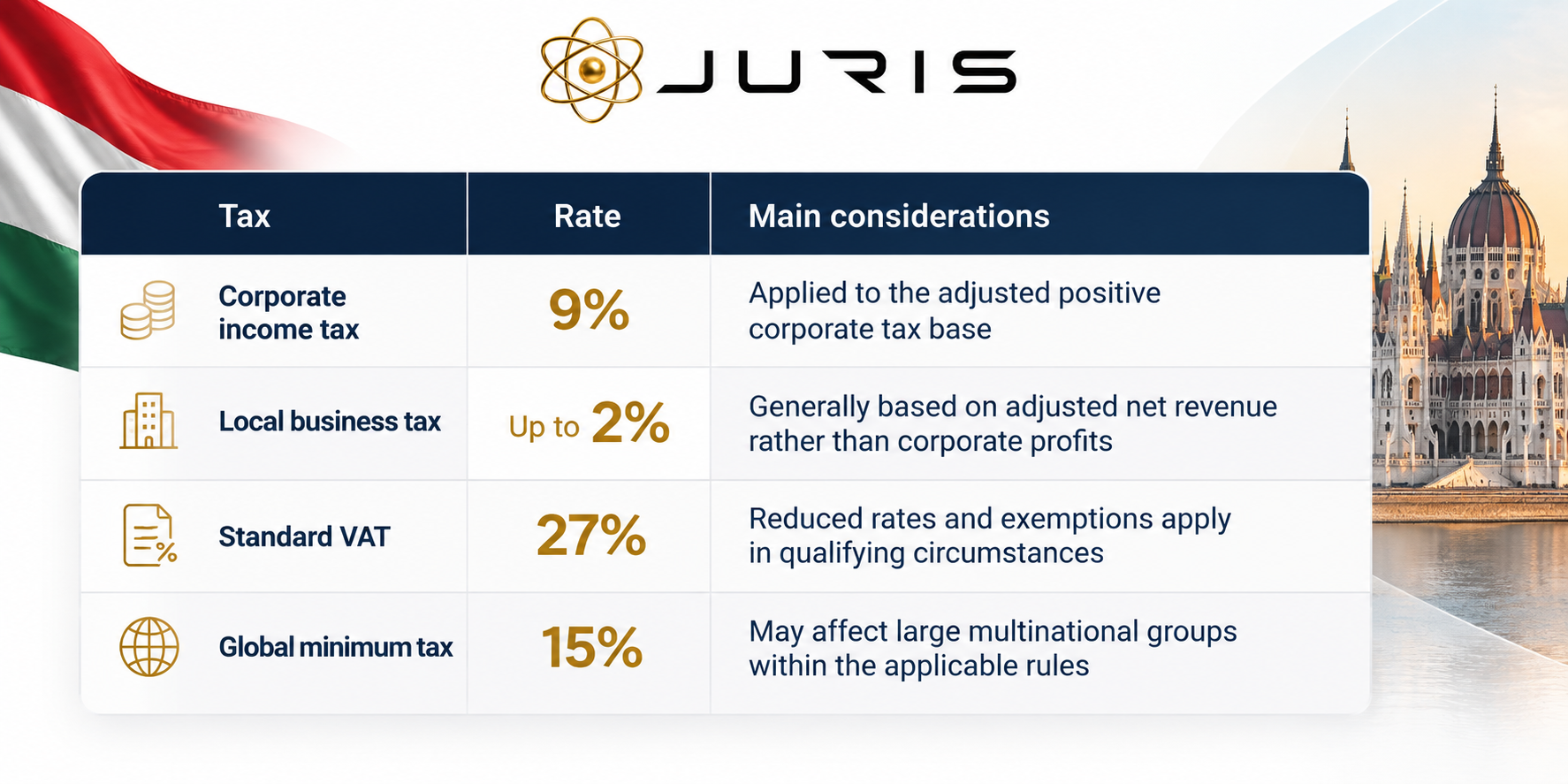
Hungary applies a flat 9% corporate income tax on its positive taxable corporate income base.
This makes the country particularly interesting for entrepreneurs considering an operational business, regional headquarters or certain international holding structures.
However, the headline tax rate does not necessarily represent the company's total tax burden.
Hungarian businesses may also be subject to a local business tax of up to 2%, depending on the municipality.
Importantly, the two taxes are calculated differently.
For trading companies, service providers and international businesses, understanding these differences is essential.
A low corporate tax rate is attractive, but the overall tax position depends on the company's activities, costs, ownership and international exposure.
2. Incorporation Does Not Guarantee Banking Access
One of the most underestimated challenges of international company formation is banking.
Under Section 114 of Hungary's Act CL of 2017 on the Rules of Taxation, domestic legal entities are generally required to maintain at least one domestic business payment account.
The first qualifying account must be opened within 15 days following notification of the company's tax identification number.
This requirement makes banking an immediate operational consideration rather than something to address months after incorporation.
Foreign-owned businesses may face additional scrutiny from financial institutions, particularly where ownership structures, sources of funds or commercial activities are complex.
Banks will generally need to understand:
- The identity and background of the ultimate beneficial owners.
- The origin of invested funds.
- The company's intended business activities.
- Expected transaction volumes and payment flows.
- The relationship between the business and Hungary.
- The countries where customers and suppliers are located.
A company may be legally registered without being commercially ready to operate.
The practical lesson is simple: banking feasibility should be evaluated before incorporation, not afterwards.
3. Economic Substance: Why Is the Company in Hungary?
nternational tax planning increasingly requires credible explanations for the location of business activities.
Consider an entrepreneur who establishes a Hungarian company while continuing to manage every aspect of the business from another country.
Although the company is registered in Hungary, several questions arise.
Where are the strategic decisions made? Where are contracts negotiated? Who manages the business? Where are its employees and operational activities located?
These questions can influence banking assessments and international tax consequences.
A credible Hungarian business presence might include local management, employees, suppliers, office facilities or other genuine commercial activities.
Not every company requires the same operational structure, and foreign ownership is not inherently problematic.
However, the legal structure should accurately reflect how and where the business is actually managed.
A Hungarian company should not be viewed as an automatic solution to taxation in another jurisdiction.
4. Can Foreign Entrepreneurs Obtain Hungarian Residency?
For internationally mobile business owners, Hungary also provides opportunities to combine investment or entrepreneurship with immigration planning.
Two routes deserve particular attention.
Guest Self-Employment Residence Permit
This permit may be available to qualifying third-country nationals undertaking independent remunerated activities or acting as chief executives of qualifying business organisations.
Key characteristics include:
- Initial validity of up to one year.
- Extension potentially available for up to two additional years.
- A three-year maximum within the relevant extension cycle.
- Extension conditions that include at least 90 days of residence in Hungary during any 180-day period.
Importantly, owning shares in a Hungarian company does not automatically establish eligibility for residency.
Applicants must satisfy the immigration requirements applicable to their intended activities.
Guest Investor Programme
Hungary also operates an investment-based residency programme offering qualifying third-country nationals residence permits valid for up to ten years, with the possibility of extension.
Current qualifying investments include:
- €250,000: Investment in qualifying real estate investment fund units.
- €1,000,000: Qualifying donation to an eligible higher education institution.
The €250,000 investment fund route includes a five-year blocking requirement for the relevant investment units.
A particularly interesting feature is the absence of a general mandatory minimum physical stay for holders of the Guest Investor residence permit.
The permit also provides rights to undertake qualifying business and employment activities in Hungary.
However, eligibility, source-of-funds verification, sanctions restrictions and financial institution acceptance must be assessed individually.
For some international entrepreneurs, this may offer considerable immigration flexibility.
5. Residency Is Not the Same as Tax Residency
This is one of the most important distinctions in international mobility planning.
Holding a Hungarian residence permit does not automatically make an individual a Hungarian tax resident.
Immigration residence and tax residence are governed by different legal frameworks.
Personal tax residence can depend on factors such as domestic statutory rules, permanent home, centre of vital interests, habitual residence and applicable double-taxation treaties.
Hungarian tax residents are generally liable to Hungarian personal income tax on worldwide income, subject to the relevant exemptions and treaty provisions.
Non-residents generally face a more limited Hungarian tax liability.
Consequently, obtaining a ten-year Guest Investor residence permit should not be confused with obtaining an automatic exemption from Hungarian taxation.
Similarly, incorporating a Hungarian company does not necessarily eliminate taxation or reporting obligations in the entrepreneur's country of personal residence.
The location of effective management, permanent establishment rules and international anti-avoidance provisions may all become relevant.
6. The Structure Must Work Beyond the Company Register
For international entrepreneurs, company formation should be treated as one component of a broader strategy.
Before establishing a Hungarian corporate structure, several issues deserve attention:
1) Corporate structure: Who will own and control the company, and what commercial purpose will it serve?
2)Banking: Can the proposed business satisfy the requirements of an appropriate financial institution?
3)Taxation: What taxes will arise in Hungary and potentially in other relevant jurisdictions?
4)Management: Where will the company's actual management and decision-making take place?
5)Residency: Does the owner require immigration permission to live or work in Hungary?
6)Ongoing compliance: How will accounting, tax reporting, beneficial ownership disclosures and regulatory obligations be handled?
These considerations are interconnected.
For example, obtaining a residence permit may facilitate an entrepreneur's genuine presence in Hungary, but it does not guarantee banking approval or resolve all international tax questions.
Likewise, incorporating a company with a local director does not automatically establish sufficient economic substance.
The value of an international business structure lies in its ability to function lawfully and sustainably, not simply in how quickly it can be registered.
7. JURIS Global Perspective
It is whether that company can operate successfully within a structure that makes sense from a banking, regulatory, immigration and international tax perspective.
For investors and business owners, this requires a coordinated approach.
The right international strategy considers not only where a company is incorporated, but also where its owners live, where decisions are made, how funds move and how the overall structure is taxed.
In international business, incorporation creates the legal entity. Proper planning creates a business that can actually operate.
Your next step
Speak to an adviser
Tell us what you need. The JURIS team will review your enquiry and help you find the right support.