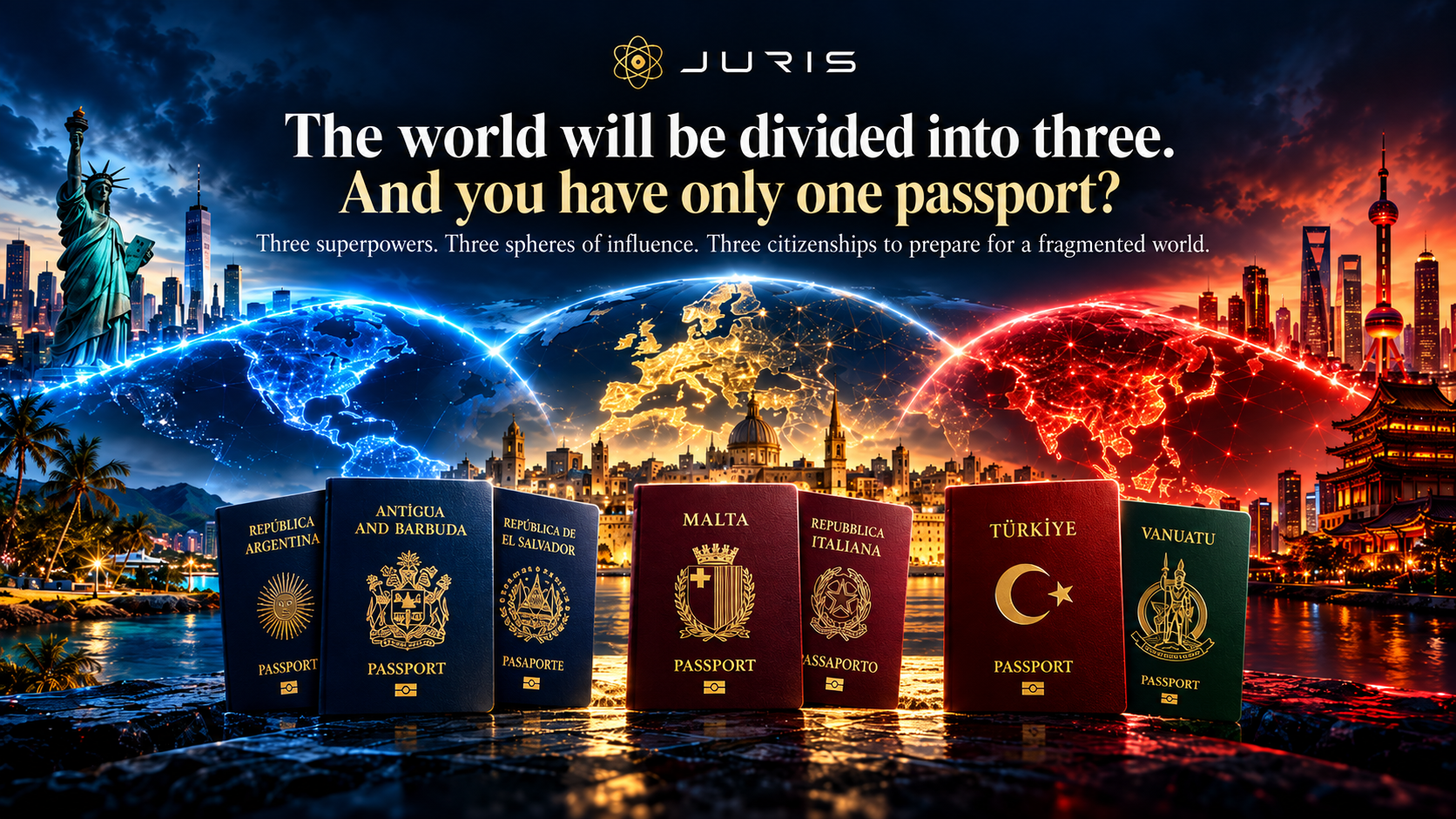
🇺🇸 🇪🇺 🇨🇳 The world will be divided into three. And you have only one passport?
A thought-provoking article exploring a possible future of three major geopolitical spheres (US-Americas, China-Asia, and a contested Europe). It argues that in a more fragmented world, holding a single passport may no longer be enough, and proposes a strategic diversification through three citizenships: one in the Americas (Antigua, Argentina or El Salvador), one in Europe (Malta), and one in Eurasia (Turkey, with Vanuatu as an additional option). The piece reframes citizenship as a form of geopolitical risk management rather than just travel freedom.
JURIS Editorial
Three superpowers. Three spheres of influence. Three citizenships to prepare for a world that may no longer be the one we know.
What if the future of the world has already been partly decided?
Let us imagine a scenario.
Not a new world war. Not necessarily tanks in our cities. But something quieter and more structural:
A redefinition of global balances.
A world organised around three major poles of influence:
🇺🇸 United States – The Americas
Washington consolidates its hegemony over the American continent, from Canada to Tierra del Fuego, through alliances, economic influence and control of strategic trade routes.
In this scenario, North, Central and South America become increasingly integrated into a US-centred economic and geopolitical sphere.
🇨🇳 China – Asia and Africa
Beijing strengthens its dominant role in the commercial, technological and financial networks of the Asia-Pacific, becoming the gravitational centre of much of the continent.
But China's ambitions may extend far beyond Asia.
Africa could become the second major pillar of Beijing's global sphere of influence.
Through infrastructure investments, strategic ports, financing, trade agreements and access to critical minerals, China has already established a significant economic presence across the African continent.
China has become Africa's largest trading partner, and its economic relationships extend from major infrastructure projects to mining, energy and telecommunications.
Now imagine this influence expanding over the next decade.
Rather than conquering territory through military force, Beijing could progressively bring large parts of Africa into its economic and strategic orbit, gaining greater influence over supply chains, natural resources and international trade routes.
In this scenario, China could emerge as the dominant economic power across much of Asia and Africa, creating a vast sphere of influence connecting two continents.
Of course, Africa is not a single political entity. African nations have their own interests, alliances and strategic ambitions. Many will continue balancing relationships with China, the United States, Europe and other powers.
But the question remains:
Could economic influence ultimately become more powerful than military control?
🇪🇺 🇷🇺 Europe – A Contested Space
Europe does not automatically become a Russian sphere.
But it risks turning into a more fragmented area, subject to multiple pressures: American influence in the West, Russian pressure in the East, and growing economic and technological competition with China.
In this scenario, European strategic autonomy is not guaranteed.
Does this sound like a conspiracy theory?
Perhaps.
But the return of spheres of influence is already a topic of discussion in geopolitical analysis.
Of course, this division is not a fixed destiny. Europe could strengthen its own autonomy, while powers such as India, Japan and Brazil could make the picture far more multipolar.
But the real question is different.
If the world became more fragmented and relations between these poles more tense, what would be the true value of your passport?
The End of the "Most Powerful" Passport
For decades, we have measured the value of citizenship by counting how many countries it allows us to visit without a visa.
In a more divided world, however, the number of tourist destinations may become less relevant than the ability to settle, work, protect capital and keep options open in different jurisdictions.
What if the future was not about having the most powerful passport, but about holding three strategically diversified citizenships?
Not necessarily the three passports with the highest visa-free rankings.
But three nationalities representing different geopolitical environments, legal systems and economic alliances.
Here is how I would approach such a strategy.
🇦🇬 🇦🇷 🇸🇻 1. The Americas: Antigua, Argentina or El Salvador
The first pillar is citizenship in the American continent.
Three jurisdictions deserve attention.
🇦🇬 Antigua and Barbuda – From USD 230,000
Antigua and Barbuda has offered a Citizenship by Investment programme for years, allowing qualified investors and their families to obtain citizenship through an approved contribution or investment.
The minimum National Development Fund contribution starts at USD 230,000, excluding government processing, due diligence and professional fees.
🇦🇷 Argentina – From USD 350,000 (announced)
Argentina is entering the investment migration market with a new citizenship pathway.
On 2 October 2026, the government announced two planned options: a non-refundable contribution of USD 350,000 or a dedicated government bond subscription of USD 800,000.
Applications are expected to open during the fourth quarter of 2026, subject to the programme's implementation.
Beyond the investment requirements, Argentina offers something strategically interesting: citizenship in a major South American country, with regional mobility rights linked to Mercosur arrangements.
🇸🇻 El Salvador – USD 1M+
El Salvador has positioned itself with an approach oriented towards international capital, digital assets and economic transformation.
Its Freedom Passport initiative offers an investment-based citizenship pathway involving a contribution of approximately USD 1 million.
These three jurisdictions are very different.
But they share one important characteristic: they provide potential opportunities to obtain citizenship in the Americas without relying exclusively on one's country of origin.
In a hypothetical world of regional spheres of influence, that geographical diversification could become strategically relevant.
🇲🇹 2. The Second Element: A European Citizenship
For non-EU citizens, a European passport remains one of the most valuable tools for living, working and moving freely across the European Union.
But what about those who already hold a European passport?
I believe that even European citizens should consider the strategic value of a second European nationality.
Why?
Because holding only one nationality means depending on one country's citizenship laws, political decisions and long-term stability.
A second EU citizenship can provide another layer of legal diversification and potentially reduce exposure to changes affecting one's original nationality.
This is why I consider Malta an interesting option.
Malta offers an established legal system, English as an official language, EU membership and a strategic Mediterranean location.
Following the closure of its citizenship-by-investment programme, Maltese citizenship remains possible through naturalisation under the applicable legal requirements, including a genuine residence-based pathway.
Ordinary naturalisation involves substantial residence requirements, eligibility checks and a discretionary government decision. Meeting the qualifying conditions does not guarantee approval.
The objective is not necessarily to gain more countries to visit. It is to reduce dependence on a single nationality.
In a world where political and economic circumstances can change, even Europeans should ask themselves:
Is one European citizenship really enough?
🇹🇷 🇻🇺 🇸🇹 3. Eurasia, Asia-Pacific and Africa: Turkey, Vanuatu or São Tomé
The third pillar is perhaps the most interesting.
If the world became increasingly divided between competing geopolitical blocs, I would look beyond the traditional Western citizenship options.
Three countries deserve particular attention.
🇹🇷 Turkey – From USD 400,000
If I had to choose a country that represents a bridge between different worlds, I would look at Turkey.
Geographically straddling Europe and Asia, Turkey maintains economic and diplomatic relationships with actors from multiple geopolitical spheres.
It is a NATO member, but also maintains significant relations with Russia, China and countries across the Middle East.
Turkey offers the possibility of obtaining citizenship through qualifying real estate investment starting from USD 400,000, with a minimum three-year holding commitment and subject to legal requirements.
Its value in this hypothetical scenario does not lie in providing automatic access to China or Russia.
It lies in holding citizenship in a country with a geopolitical position distinct from both the European Union and the Americas.
🇻🇺 Vanuatu – From Approximately USD 135,000
Located in the South Pacific, Vanuatu represents another geographical diversification opportunity within the Asia-Pacific region.
Its Citizenship by Investment framework offers a relatively fast route to citizenship, with the Development Support Programme requiring a minimum contribution of USD 130,000 for a single applicant, plus due diligence and other applicable fees.
However, the passport comes with important limitations.
In particular, Vanuatu lost its visa-free access to the European Union, demonstrating that passport mobility privileges can change as a result of international political decisions.
Vanuatu is therefore not a substitute for Turkey, but it could serve a different purpose within a broader citizenship strategy.
🇸🇹 São Tomé and Príncipe – From USD 90,000
And what about Africa?
If Africa becomes increasingly important within China's economic sphere of influence, holding an African citizenship could represent another interesting layer of geopolitical diversification.
This is where São Tomé and Príncipe enters the picture.
A small island nation in the Gulf of Guinea, São Tomé and Príncipe introduced a Citizenship by Investment programme with a minimum contribution of USD 90,000, excluding additional application and professional fees.
But there is another interesting geopolitical element.
In September 2024, São Tomé and Príncipe and China elevated their diplomatic relationship to a strategic partnership.
The two countries have developed cooperation in infrastructure, economic development and other strategic sectors.
In a future where China becomes an increasingly influential economic partner across Africa, São Tomé and Príncipe could represent an interesting jurisdiction to consider.
Of course, holding its citizenship does not automatically provide access to China, residence rights throughout Africa or protection from geopolitical restrictions.
Its potential value lies in obtaining a nationality in a different region, under a distinct legal and political system.
And that brings us back to the central argument:
The strategic value of a passport may increasingly depend on where it positions you geographically and politically, not only on how many countries you can visit.
The Real Plan B May Not Be What We Think
Imagine waking up in 2035.
International relations are more tense.
Some borders have become harder to cross.
Obtaining residence permits and visas has become more selective and politically sensitive.
Access to international financial systems may depend increasingly on nationality, residence and compliance with sanctions.
Having capital may not be enough.
Having only one passport could mean depending entirely on the decisions of a single government.
Three citizenships, accompanied where necessary by effective residence rights, do not make anyone immune to wars, sanctions or restrictions.
But they can offer additional options and potentially reduce certain forms of geopolitical concentration risk.
And perhaps the greatest benefit is not the ability to travel.
It is the ability to choose where to rebuild your life if the world around you changes.
The JURIS Global Perspective
No one can know with certainty how the world will be organised in ten or twenty years.
And no one is claiming that the United States, China and Russia have already signed a secret agreement to divide the planet.
But I believe that the traditional concept of citizenship deserves deeper reflection.
We have learned to diversify investments, currencies, banks, assets and tax residences.
Why do we continue to regard citizenship as something that must necessarily depend on a single country?
Perhaps the next major shift in international planning will not concern only where to invest or where to pay taxes.
It will concern which states we choose to belong to.
The future may not belong to those with the most powerful passport.
It may belong to those who have built genuine legal connections with more than one country and preserved the freedom to make choices when circumstances change.
And perhaps one day the real question will no longer be:
What is the most powerful passport in the world?
But:
If the world became divided tomorrow, on which side could you still live?
Disclaimer: This article is intended for informational and educational purposes only. The geopolitical scenarios discussed are hypothetical and should not be interpreted as predictions of future events. Citizenship and residency laws, investment requirements and international agreements may change. Multiple citizenships do not guarantee protection against political, economic or legal risks. Eligibility, dual nationality rules, tax consequences and actual residence rights must be assessed individually with qualified professional advisers. Investment amounts mentioned are indicative minimums and may exclude government, due diligence and professional fees.
Your next step
Speak to an adviser
Tell us what you need. The JURIS team will review your enquiry and help you find the right support.