Political Orientation and Investment Migration: What CBI and RBI Investors Should Watch
If Western (and other) governments continue moving toward more restrictive migration policies, Citizenship by Investment (CBI) and Residency by Investment (RBI) programmes will not disappear, but they will become more selective, more expensive, and more politically exposed. Political risk is now one of the most underestimated factors when evaluating a second residency or citizenship.
JURIS Editorial
A pragmatic look at how different political orientations tend to approach CBI and RBI programmes
What will happen to the Citizenship and Residency by Investment sector if the political world continues moving toward increasingly restrictive migration policies?
In recent years, across much of the Western world and beyond, we have witnessed the rise of conservative and nationalist political movements favouring tighter control of immigration. From Europe to the United States, and into parts of Latin America, the political debate increasingly focuses on border security, the economic sustainability of immigration, and the protection of national interests.
This is a deeply political shift, fuelled in part by the perception that past migration policies have not always delivered the expected economic and social results.
Yet there is one question our industry should start asking itself more seriously:
If governments are becoming more selective about immigration, what guarantees that this trend will not eventually affect international investors and High-Net-Worth Individuals as well?
1. When Politics Meets International Mobility
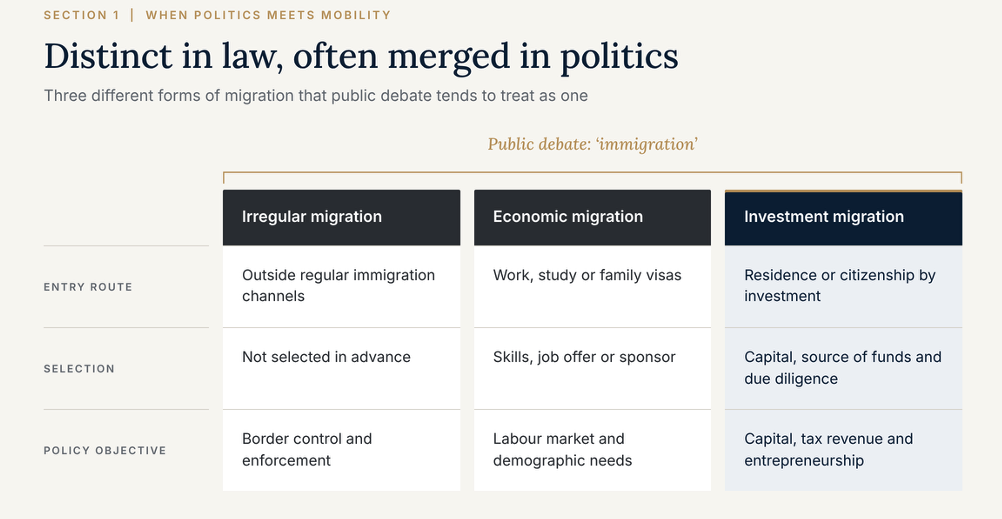
For many years, the immigration debate centred mainly on irregular flows, integration challenges, and social and economic costs. Citizenship by Investment (CBI) and Residency by Investment (RBI) programmes, by contrast, followed a different logic: attracting capital, entrepreneurs, and financially independent individuals.
However, a growing political contradiction is becoming harder to ignore.
How can a government win elections by promising to reduce immigration while simultaneously maintaining programmes that allow foreign investors to obtain residency or citizenship through an investment?
Economic immigration, irregular immigration, and investment migration are fundamentally different phenomena. A High-Net-Worth Individual who legally obtains residency or a passport is not an irregular migrant.
But politics does not always operate through technical distinctions. When public opinion demands greater border control, even programmes designed for wealthy investors can come under pressure.
2. Even Wealthy Investors May Face Greater Restrictions
Imagine a Turkish, Indian, Chinese, or Middle Eastern citizen seeking European residency through a Golden Visa, or an international entrepreneur acquiring a second citizenship to diversify mobility, investment options, and relocation possibilities.
Today these strategies work, provided they comply with applicable regulations. But what happens if governments begin to view these programmes as incompatible with their broader migration policies?
We could see:
Higher investment thresholds
Stricter scrutiny of the source of funds and personal background
Increased physical presence requirements
Nationality-based restrictions
Changes to renewal or maintenance conditions
Suspension or outright closure of certain programmes
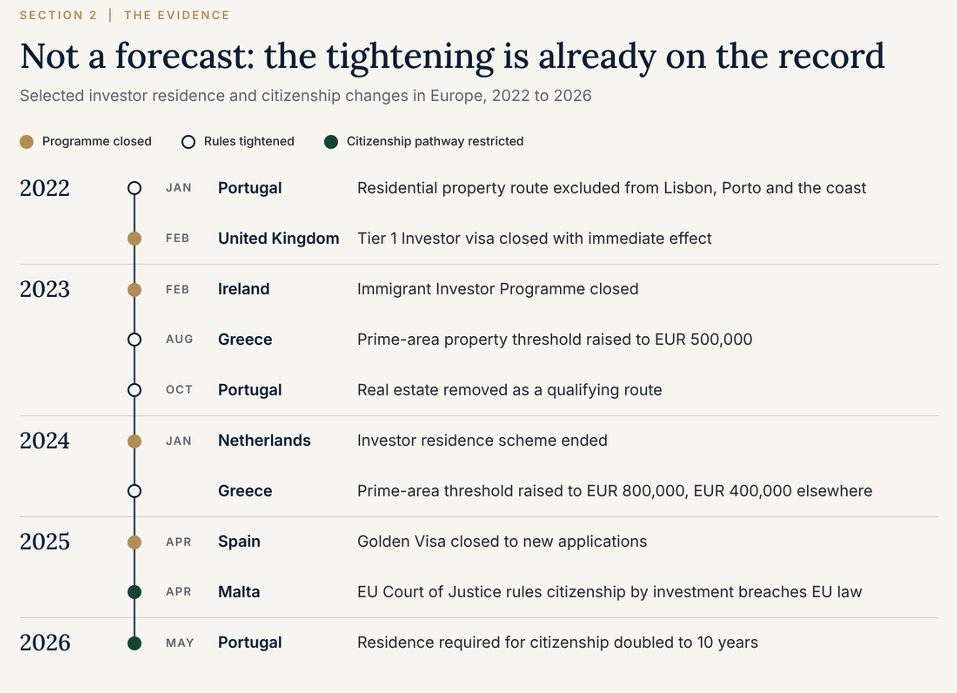
Concrete examples already exist. Spain has announced the end of its Golden Visa, Portugal has removed the real-estate option in major cities, and Greece has significantly raised its investment thresholds.
This is not speculation. It is already happening in several countries. Political risk is becoming an increasingly important variable in international mobility planning.
3. Political Risk: A Frequently Underestimated Factor
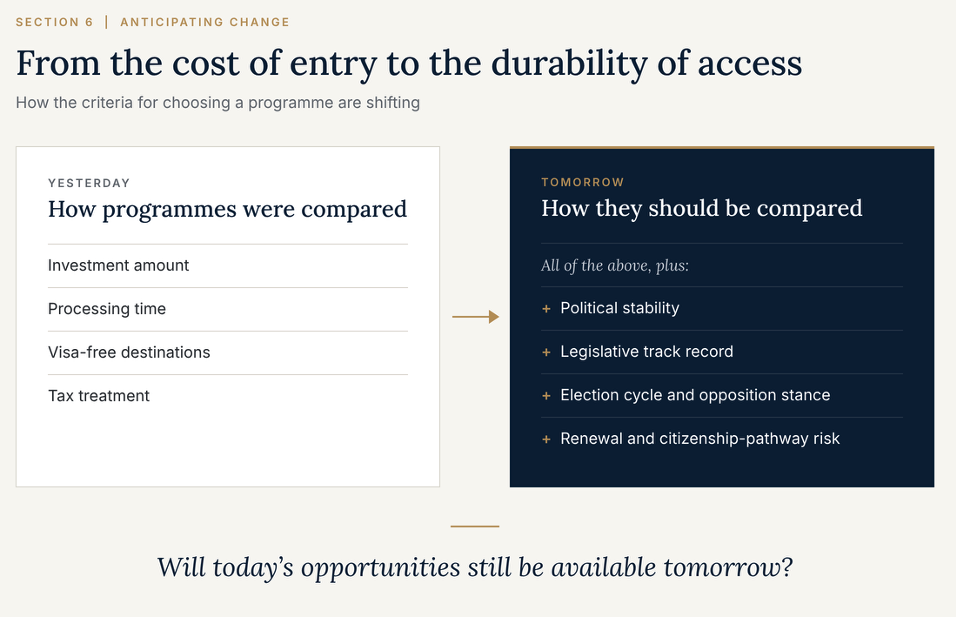
When evaluating a residency or citizenship programme, most people focus on four elements: required investment, tax implications, processing times, and mobility benefits.
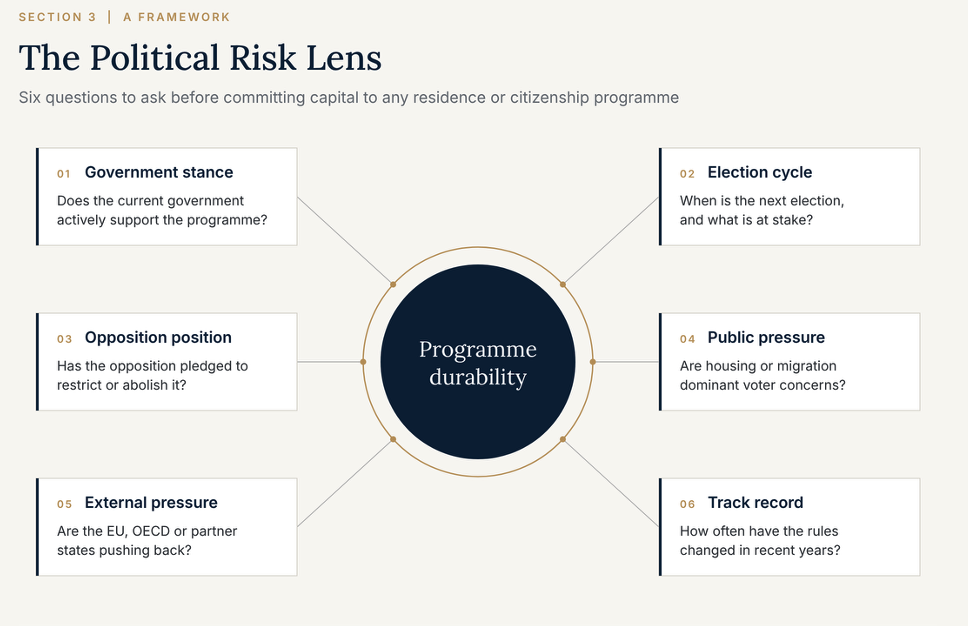
But how many seriously analyse the political situation?
Who currently governs the country? When are the next elections? Which parties could come to power? What is their stated position on immigration and foreign investors? Have they already declared an intention to limit, modify, or abolish investment migration programmes?
These questions can be as important as the cost of the investment itself.
An international residency is not merely an administrative procedure. It is a long-term strategic decision exposed to political and regulatory risk. Assessing political stability and the likely orientation of future governments should become an integral part of any serious investment migration strategy.
A Pragmatic Analysis: How the Right and the Left Tend to Approach Investor Programmes
Looking at political dynamics in recent years, a relatively clear difference in approach emerges between the main political families, though with many national exceptions.
Governments of a conservative or centre-right orientation generally tend to restrict mass and irregular immigration. At the same time, they often maintain or defend dedicated channels for high-net-worth investors (Golden Visas, residency-by-investment programmes, entrepreneur visas), viewing them as a form of selective immigration that brings capital without generating significant social costs.
Governments of a progressive or centre-left orientation, by contrast, are usually more open or less restrictive toward general migration flows. However, they tend to view programmes that allow residency or citizenship through investment with greater scepticism, often regarding them as inequitable or as contributors to housing-market pressure. In addition, more aggressive tax policies targeting large fortunes can reduce a country’s attractiveness for High-Net-Worth Individuals, even when borders remain relatively open.
This does not mean there is an automatic rule. Decisions to close or reform programmes have been taken by governments of both political orientations. Nevertheless, one fact remains: the political risk attached to Citizenship and Residency by Investment programmes does not depend solely on how open a government is to immigration, but on what kind of immigration it prioritises and on its overall relationship with private capital.
For this reason, anyone evaluating a second residency or citizenship should examine not only the current political orientation, but also the concrete priorities of the main parties regarding international investors, taxation, and border control.
4. Governments Want Capital, But They Also Need Votes
Here lies one of the most interesting aspects of the sector’s future.
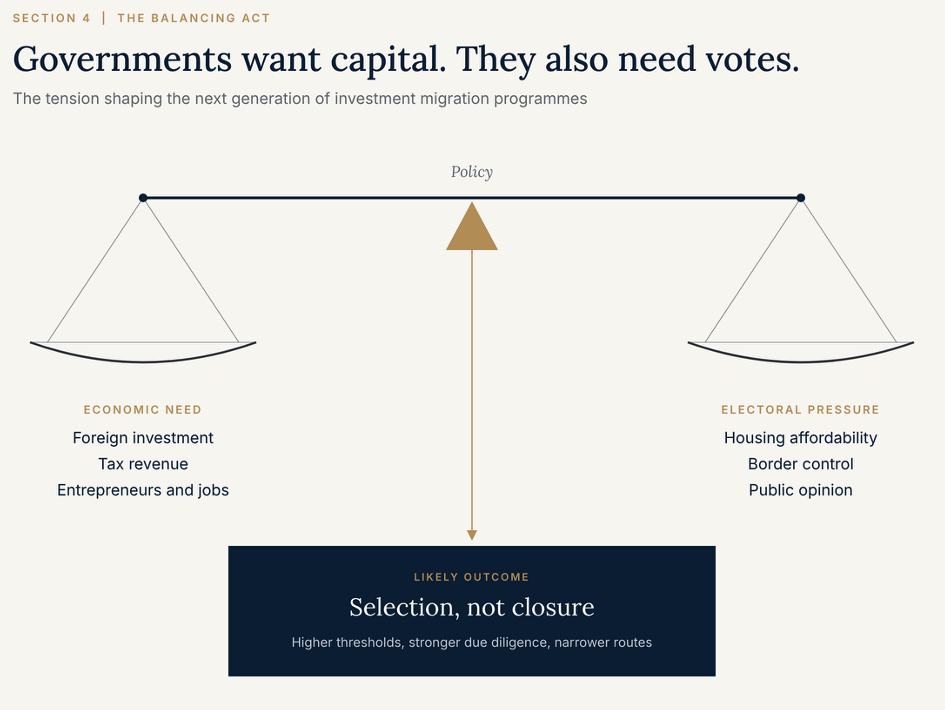
On one hand, many countries need to attract foreign investment, entrepreneurs, and high-income taxpayers. On the other, the same governments must respond to an electorate that often demands tighter migration policies.
Governments want capital, but they also need votes. These two requirements do not always align.
The likely outcome is not the disappearance of CBI and RBI programmes, but their gradual transformation: a more selective market, with stronger controls, higher investment thresholds, and greater emphasis on the real economic contribution of applicants.
In other words, international mobility may become less accessible, and precisely for that reason, more valuable.
5. Why a Second Citizenship or Residency Could Become More Important Than Ever
I do not interpret these developments as the end of the industry. On the contrary.
In a world marked by rising geopolitical uncertainty, regulatory change, and more selective migration policies, holding a second citizenship or an alternative residency can become one of the most important tools of international planning.
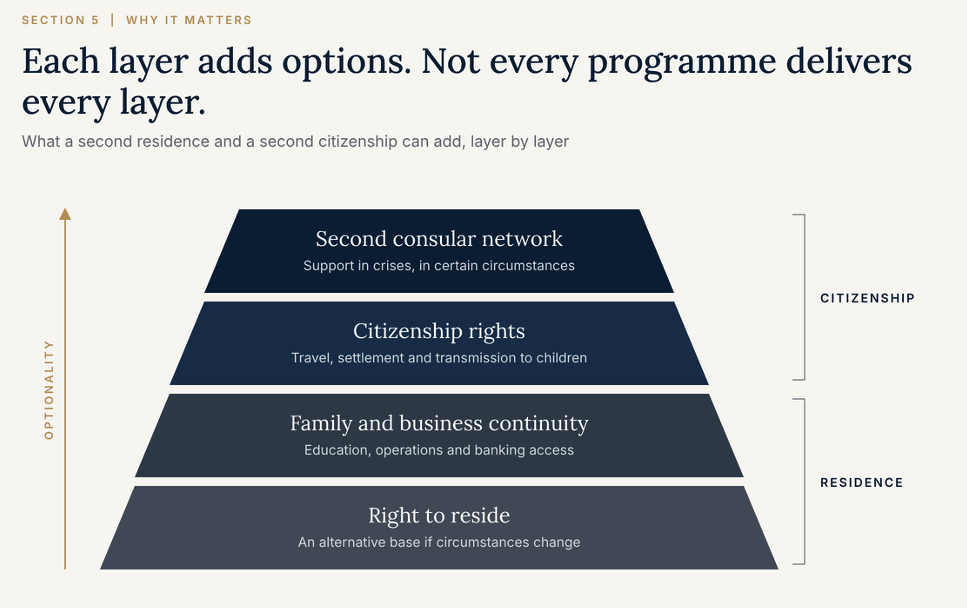
A second residency is not merely the right to live in another country. It can provide an alternative in times of instability, greater opportunities for the family, business continuity, and access to new jurisdictions.
A second citizenship adds further rights and mobility options. And there is one frequently underestimated advantage: broader consular protection.Holding two citizenships means that, in certain circumstances, an individual can also rely on the diplomatic and consular network of a second state in the event of crises, conflicts, or international emergencies.
Of course, these tools must be planned carefully. Not all programmes offer the same guarantees, not all residencies confer the same rights, and not all passports provide permanent, unconditional access to the same destinations.
Above all, we cannot assume that the opportunities available today will continue to exist under the same conditions tomorrow.
Each layer adds options. Not every programme delivers every layer.
6. The Real Challenge Will Be Anticipating Change
After more than twelve years in the citizenship and residency-by-investment sector, I believe the role of international mobility professionals is evolving.
It will no longer be enough to compare programmes solely on price, processing speed, or the number of visa-free destinations. It will become increasingly important to understand political developments, the stability of regulations, the risks linked to changes in government, and the long-term sustainability of programmes.
Obtaining residency today is important. Understanding whether that residency will still meet one’s needs in five or ten years may be even more important.
The question is no longer only the cost of entry, but the durability of access.
A Final Reflection
The world is changing, and politics will continue to shape how people can live, invest, and move beyond their national borders.
We do not know whether future governments will become more restrictive toward international investors, or whether the economic need to attract capital will prevail. We will probably see both trends, depending on the country.
But one thing seems increasingly clear:
In a world where governments may become more selective about who can enter and settle in their territory, having already built an international mobility strategy could represent a significant advantage.
The question is therefore no longer simply which passport is strongest or which Golden Visa is most affordable today.
The real question is: will the opportunities we have today still be available tomorrow? And more importantly, are we paying enough attention to the politics of the countries in which we choose to invest and obtain a second residency?
Carlo Alberto Rovere - International Mobility & Investment Migration Professional
Disclaimer
This article is published by JURIS Global for informational and educational purposes only. It reflects an independent analysis of political trends and their potential impact on Citizenship by Investment (CBI) and Residency by Investment (RBI) programmes.
The views expressed do not constitute political endorsement, legal, tax, immigration, or investment advice. Political developments, government policies, and programme requirements may change at any time.
Readers should conduct their own due diligence and seek advice from qualified professionals before making any residency, citizenship, or investment decisions.