🇭🇺 Hungary’s Draft Wealth Tax: A New Factor in Residence and Investment Decisions
Hungary’s proposed wealth tax could reshape investment decisions, tax residency and international mobility for wealthy families and entrepreneurs. Dr. Robert Kaszó of JURIS Global Hungary examines the proposed rates, business implications, tax treaties and potential relocation strategies.
Dr. Robert Kaszó of JURIS Global Hungary
By Dr. Robert Kaszó, LL.M. | Juris Global Hungary Analysis of the consultation draft and published proposals as at 16 October 2026. The rules discussed are proposed legislation, not enacted obligations.
A family choosing where to live considers schools, security, business opportunities and the cost of maintaining its lifestyle. For wealthy entrepreneurs, Hungary’s proposed wealth tax would add another consideration: the annual tax cost of owning assets, including assets that produce no distributable income.
The implications run in both directions. Foreign investors considering Hungary may reconsider a full relocation. Hungarian families may explore residence abroad. Neither decision can be assessed simply by comparing headline tax rates.
The central question is how immigration status, tax residence, citizenship, asset ownership and treaty protection interact.
Hungary published the consultation package on 6 October, with comments due by 14 October. Its stated objective is to make substantial wealth contribute more to public expenditure. That objective deserves to be considered alongside the effects on productive investment and international mobility. [1]
What the draft would tax
The proposal is an annual net wealth tax assessed at year-end. After deductible liabilities, the first HUF 1 billion, approximately EUR 2.5 million at the indicative rate above, would fall outside the taxable base. The operative text applies 1% to the first HUF 100 billion, approximately EUR 250 million, of taxable base and 1.5% above that level.
At 1%, the annual tax on HUF 1 billion of taxable base would be HUF 10 million, approximately EUR 25,000. At 1.5%, the annual tax on each additional HUF 1 billion would be HUF 15 million, approximately EUR 37,500. These EUR equivalents are illustrative only.
The proposed first valuation date is 31 December 2026, with filing and payment by 31 August 2027. This would leave a short preparation period if adopted on the proposed timetable. [2]
The asset base is broad: property, financial assets, company interests, crypto-assets and specified valuable personal assets. Domestic taxpayers would generally face worldwide exposure; non-residents would face exposure to specified Hungarian assets, subject to treaties.
Trust assets and private foundations would be separate taxable arrangements rather than automatic shelters. Company valuations would distinguish listed shares from unlisted interests, with the latter drawing on equity and capitalised earnings. A profitable private company could therefore have a tax value materially different from its book equity. [3]
The economic difficulty is that a valuable business does not necessarily provide its owner with cash. Paying a personal annual tax may require dividends, borrowing or a partial sale. This is particularly relevant to family businesses that reinvest their earnings.
Which amendments have actually been proposed?
On 15 October, the Hungarian Chamber of Commerce and Industry, MKIK, confirmed that it had formally submitted amendments.
Its preferred solution is an exemption for business assets serving genuine economic activity in Hungary, including qualifying operating-company interests. It also calls for safeguards against placing passive private wealth inside companies merely to obtain relief.
Alternatively, MKIK proposes crediting an owner’s proportionate share of corporate income tax or KIVA, together with specified employment-related taxes and contributions, against the wealth tax attributable to the business interest. The credit would be capped at that interest’s wealth-tax liability. These are stakeholder proposals, not adopted provisions. [4]
A separate joint industry statement, reported on 15 October, calls for a lower 0.3–0.5% rate for wealth between HUF 1 billion and HUF 5 billion, approximately EUR 2.5 million and EUR 12.5 million respectively, alongside more careful treatment of illiquid assets, listed companies and start-ups. Published requests also include relief recognising reinvestment, energy efficiency, digitalisation, research, employee training and public-benefit donations. [5]
These proposals address different problems. A lower initial rate eases the burden near the threshold. Business relief protects productive capital. Neither, by itself, resolves international residence questions.
For Hungarians considering departure, the treaty matters
The draft’s domestic residence definition has a strong citizenship connection, expressly including dual Hungarian citizens. It provides an exception for Hungarian citizens who have lived habitually abroad for at least ten years.
A new move abroad therefore would not necessarily end domestic wealth-tax residence. A treaty covering taxes on wealth could become decisive before that ten-year condition is met. [6]
🇩🇪Germany illustrates the distinction. Its treaty with Hungary covers both income and capital. Once an individual genuinely becomes German-resident under the treaty, ordinary investment shareholdings not attributable to a permanent establishment would generally fall under the residence state’s exclusive capital-taxing right. Directly owned Hungarian real estate remains separately taxable in Hungary. [7]
The 🇦🇪 UAE treaty, by contrast, covers income taxes. A Dubai residence permit or an income-tax residence position should not be presented as automatically defeating Hungary’s proposed wealth-tax claim. [8]
Destination selection must therefore consider the applicable treaty, the evidence supporting residence and the destination’s complete tax system. A foreign address alone cannot substitute for genuine changes in personal and economic circumstances.
Nor would a foreign holding company automatically solve the problem. For an individual who remains subject to worldwide Hungarian wealth taxation, the foreign company interest remains an asset to be valued. The valuation outcome may change, but incorporation abroad does not itself create an exemption. [9]
For foreign arrivals, residence permission and tax residence must be assessed separately
Hungary’s Guest Investor Programme provides an immigration route. It should not be marketed as a guarantee of tax neutrality.
Obtaining permission to reside and establishing tax residence are different events. The analysis may involve permanent homes, family and economic connections, physical presence and treaty residence tests. Spending fewer than 183 days in Hungary is not a universal safe harbour. [10]
A family seeking an additional residence option while continuing its established life abroad may have a different exposure from a family moving its home, children and business management to Hungary.
EU citizens face the same need for tax analysis when exercising free-movement rights. An income-and-capital treaty may protect a person who remains resident abroad, but a genuine transfer of treaty residence to Hungary can shift the taxing right over financial wealth to Hungary.
The treaty distinction is commercially important. Germany, Switzerland and Ukraine have treaties with Hungary covering capital. China and the UAE have income-tax treaties. These categories describe treaty coverage, not a nationality-based exemption or a ranking of attractive destinations. Asset-specific provisions still matter. [7][8][11]
There is also a terminology trap: a long-validity Guest Investor residence permit is not automatically the statutory Hungarian “long-term residence” status. The draft’s special rule for certain holders of that separate status cannot simply be extended to every investor-permit holder. [6][12]
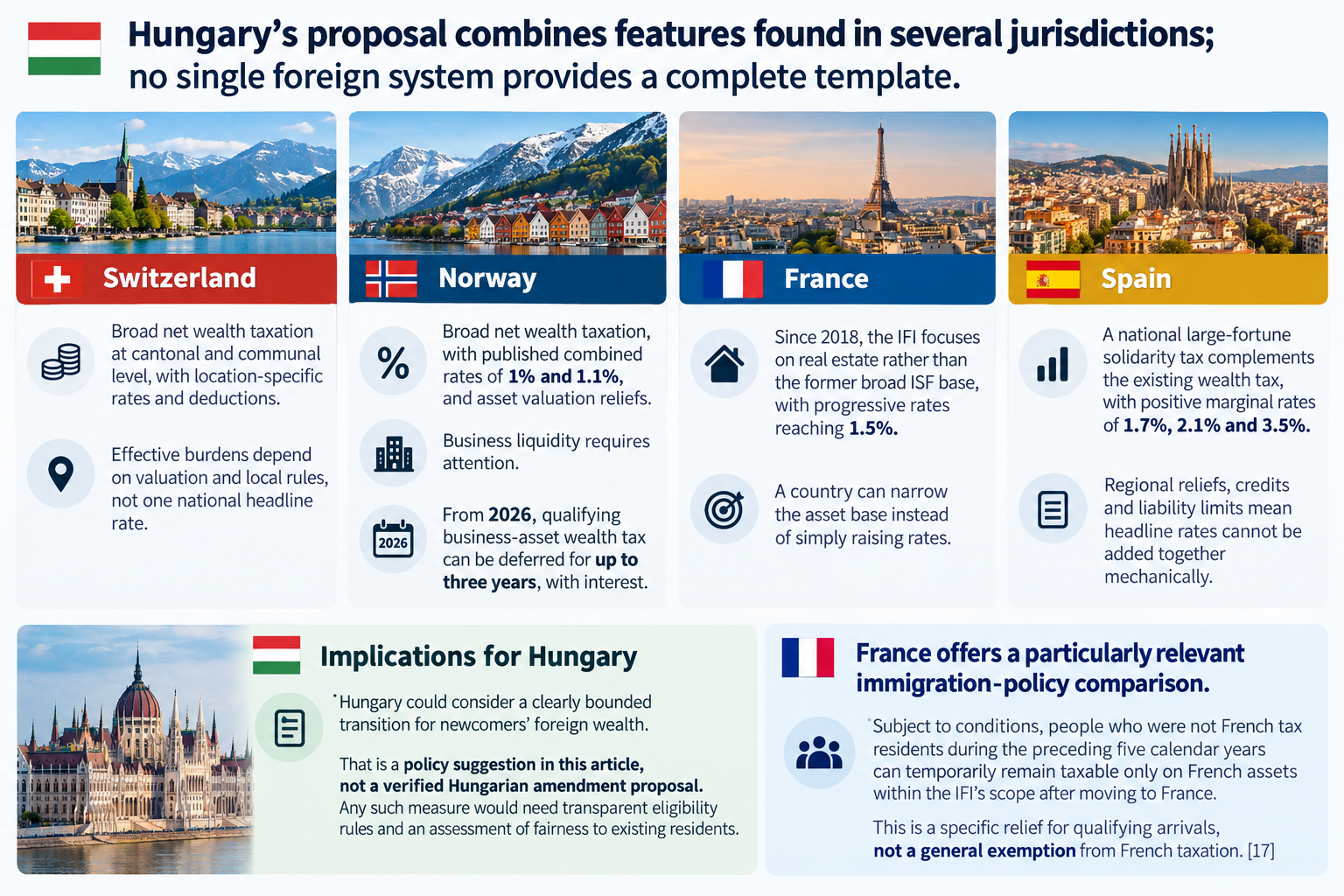
What established wealth-tax systems show
Sources: national tax administrations and legislation. [13–16]
Will wealthy families leave?
International evidence supports a migration response, but not predictions of an inevitable mass exodus.
A study published in the American Economic Review in October 2026, using Scandinavian administrative data, finds that a one-percentage-point increase in the top wealth-tax rate reduces the stock of wealthy taxpayers by approximately 2%. This is not an annual departure rate and cannot be transplanted directly to Hungary. [18]
My assessment is that internationally mobile families, owners of liquid portfolios and entrepreneurs following a business sale would be especially likely to review their position. Strong family ties and businesses rooted in Hungary would make relocation less straightforward.
The implications for investment also need precision. Ordinary companies are not themselves among the draft’s wealth-tax taxpayers. A multinational establishing a Hungarian factory is therefore in a different position from an individual owning a Hungarian company directly. The stronger immediate channel may be decisions about where owners live and where their next investment takes place. [6]
The policy choices that deserve attention
Hungary’s immigration and tax policies need to be considered together. Attracting an investor’s initial commitment is only one part of attracting the investor’s family, expertise, spending and future business activity.
In my view, the final design should prioritise predictable valuations, workable liquidity relief, clear treaty guidance and a realistic implementation period. Indexing thresholds would help prevent inflation from silently widening the tax’s reach. Any new-resident relief should be explicit rather than inferred from an immigration permit.
For families, the practical task is to model the combined outcome before moving: current and intended tax residence, asset classes, treaty coverage, ownership structures, annual cash needs and the destination’s other taxes. The model should show both HUF and EUR figures, using current exchange-rate assumptions and sensitivity ranges, while recognising that the legal liability would generally be calculated in HUF.
Hungary can pursue a greater contribution from substantial wealth while remaining attractive to entrepreneurs and international families. Whether it achieves both will depend on the detailed rules and their administration—not merely the headline rate.
Sources and editorial references
Hungarian government consultation package.
BDO: draft rates, taxable base and timetable.
CMS: draft scope and valuation provisions.
MKIK: formally submitted amendments, 15 October 2026.
Portfolio: joint industry statement; Piac & Profit: published joint proposals.
Draft statutory text: notably sections 2–4.
Hungary–Germany treaty: Articles 4 and 21.
Hungary–UAE treaty: Article 2.
ABT: residence and treaty analysis.
NAV: foreign-source income and tax residence guidance.
Treaties: Switzerland, Ukraine, China.
OIF: Guest Investor residence permit; Act XC of 2023.
Swiss Federal Tax Administration: tax statistics and cantonal differences; Swiss tax system.
French tax authority: qualifying arrivals and temporary territorial treatment.
Jakobsen et al., American Economic Review, October 2026.
Disclaimer
This article is provided for general information and discussion purposes only. It is based on a consultation draft, publicly available materials and published proposals as at 16 October 2026. The proposed Hungarian wealth-tax rules may change, may not be enacted, or may be enacted in a different form.
The article does not constitute legal, tax, accounting, immigration or investment advice, and it does not create an adviser–client relationship. The EUR amounts are illustrative conversions based on an indicative rate of EUR 1 = HUF 400. Actual exchange rates, valuation rules, treaty provisions and individual circumstances may produce materially different results.
Readers should obtain advice from appropriately qualified advisers in Hungary and any relevant foreign jurisdiction before making decisions concerning residence, immigration, asset ownership, restructuring, investment or relocation. No representation is made that the information is complete, current or applicable to any particular person or transaction.
About the author
🇭🇺 JURIS Global Hungary - Dr. Robert Kaszó, LL.M.
Dr. Robert Kaszó, LL.M., is an EU immigration lawyer and Founding partner at Westbridge Consulting focusing on international tax, tax residence, investment migration, wealth structuring and cross-border business matters. His work involves analysing the interaction between domestic tax rules, tax treaties, immigration status and family or business circumstances.
The views expressed in this article are the author’s own and are provided for analytical purposes. They do not necessarily represent the views of Westbridge Consulting or any client. Professional qualifications, authorisation requirements and the scope of services should be verified independently before engagement.
Your next step
Speak to an adviser
Tell us what you need. The JURIS team will review your enquiry and help you find the right support.