🇺🇸 US elections, AI and data centres: the market reshuffles its pecking order
The 2026 🇺🇸 U.S. elections are reshaping the technology market. While Wall Street rewards major tech companies with established infrastructure, semiconductor manufacturers and data center developers face growing pressure. Amid tighter regulations, billions in AI investments, and rising financial risks, one crucial question emerges: who will successfully turn the AI boom into sustainable profits?
Giancarlo Prisco - Juris Finance
The Democratic victory removes part of the political uncertainty, but raises a new question for investors: who benefits from slower investment, and who bears the cost?
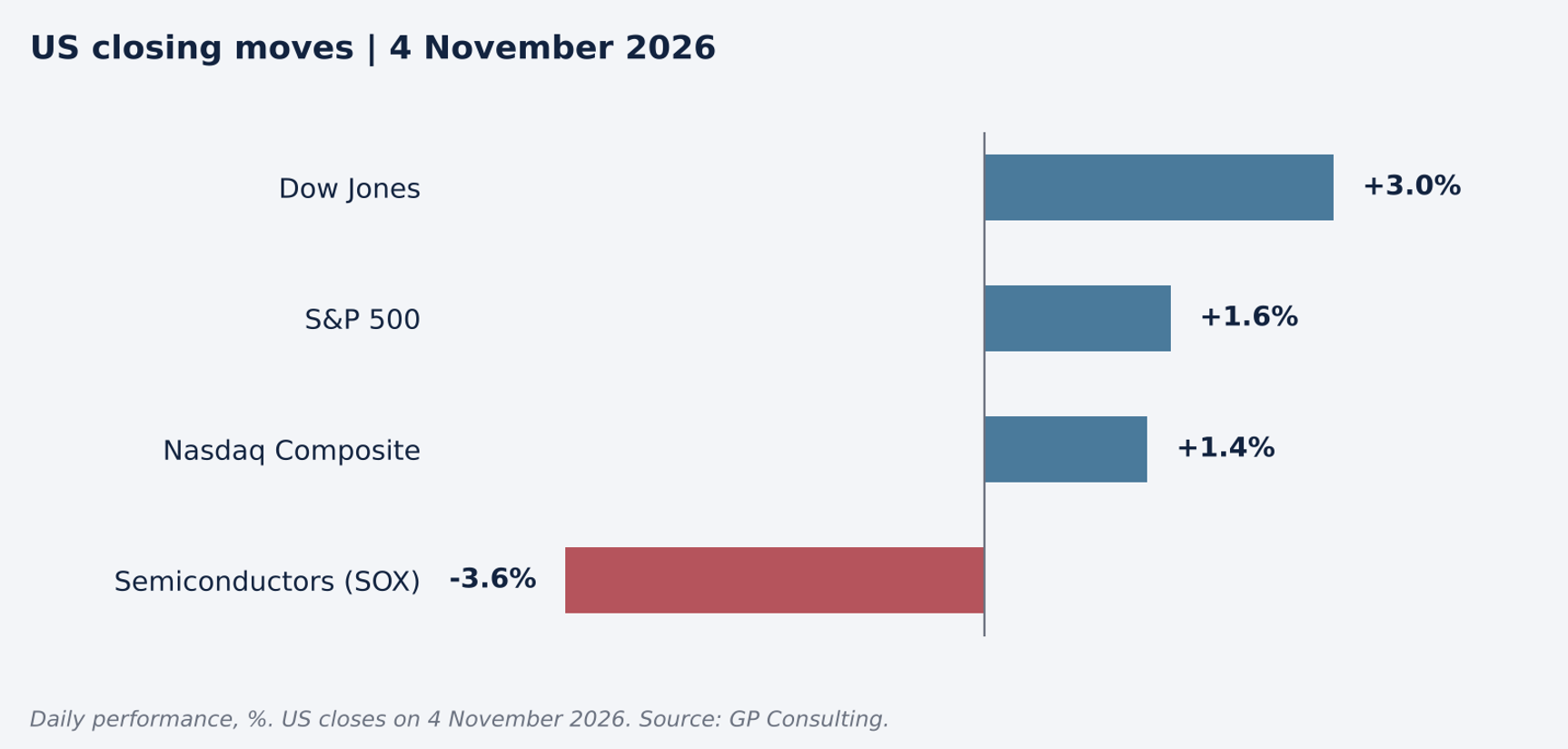
The first trading session after the vote gave only a partial answer. US equity indices rose strongly and bond yields fell, while semiconductors and companies directly exposed to data centre construction stayed under pressure. The market separated those who finance and use the infrastructure from those who still have to build it.
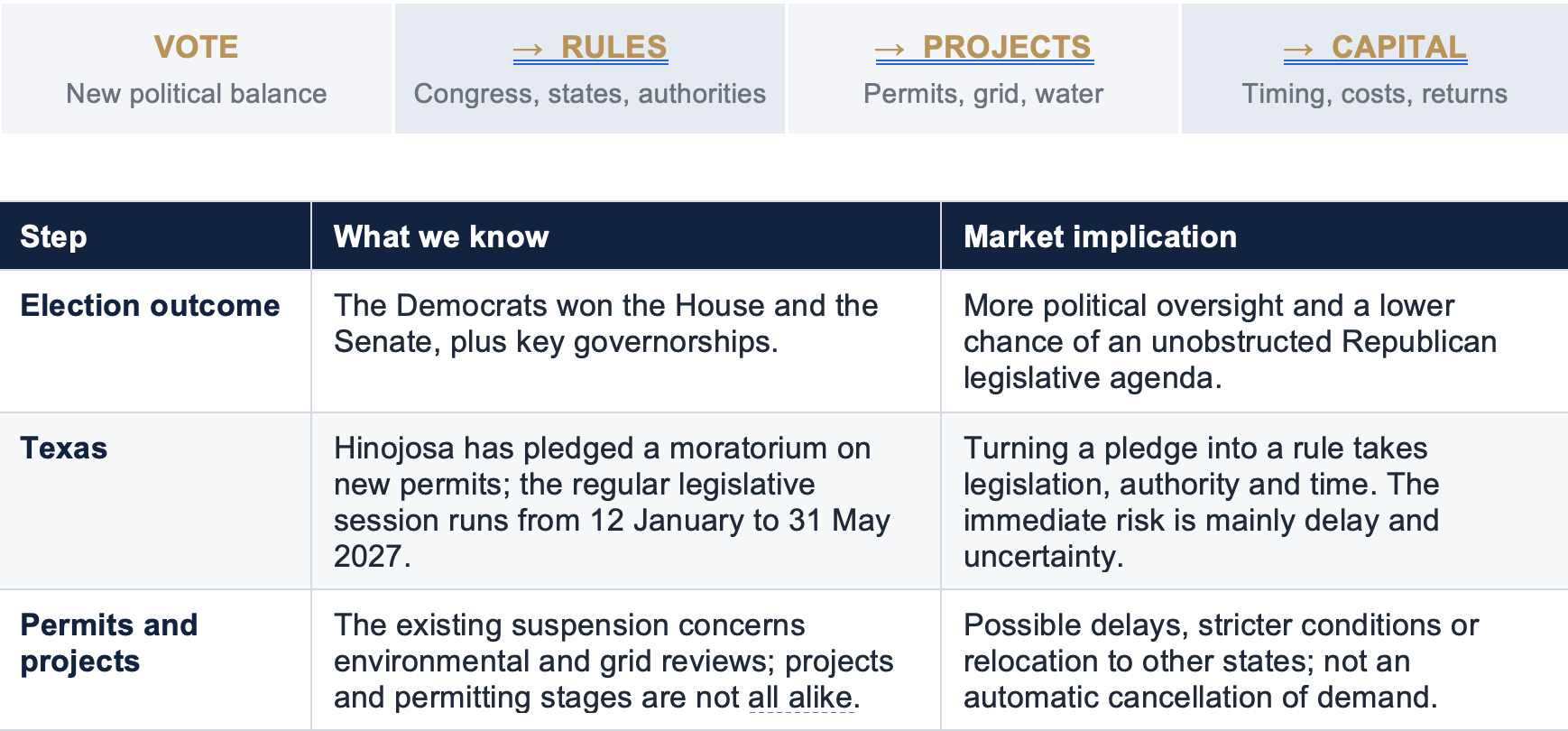
That distinction matters more than a superficial reading of a “post-election rally”. The Democrats won control of both the House and the Senate, along with victories in key states, including Texas. The prospect of tighter scrutiny of data centres supported some of the large technology groups, but weighed on suppliers, operators and stocks tied to the spending cycle.
01 | From the vote to the rules: the risk lies in the timing
A Democratic victory in both chambers reduces uncertainty about the election outcome, but does not make implementing a new agenda straightforward. A Congress at odds with the White House can slow sweeping federal reforms. Many decisions affecting data centres, however, sit with state and local authorities: environmental permits, grid interconnection, water availability, electricity tariffs and tax incentives.
Texas is the most closely watched case. Governor-elect Gina Hinojosa has pledged a moratorium on new permits until legislative safeguards are approved. But this does not start from zero: the outgoing administration had already suspended some environmental permits and grid-related procedures pending review. The campaign pledge could therefore extend or tighten a review process already under way, without meaning that every project under construction will be stopped.
Politics creates timing risk; the economic effect depends on how tied projects are to a specific site, whether they can be moved, and the cost of capital while waiting.
02 | The market told the owners apart from the builders
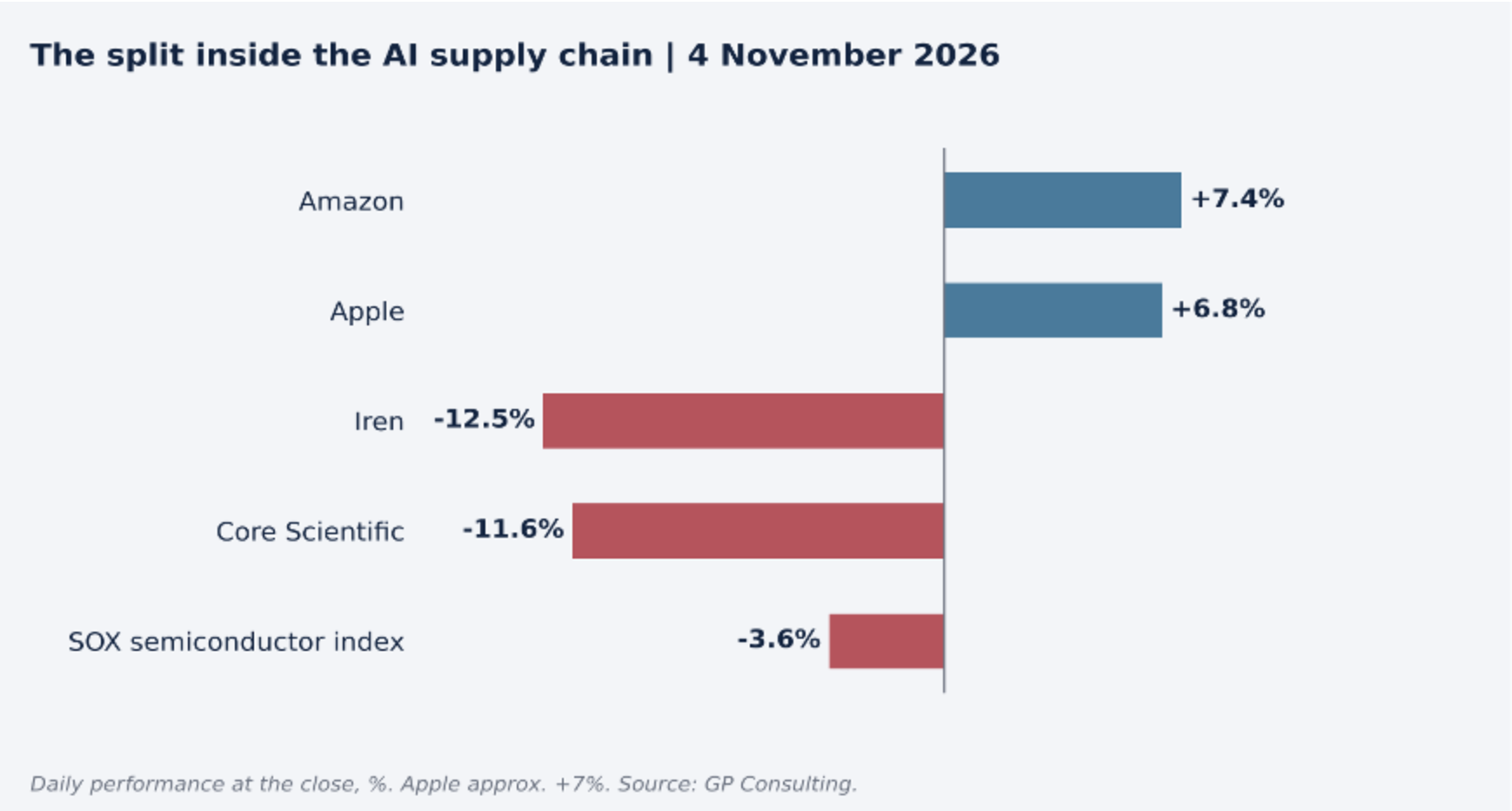
The 4 November session was not a blanket purchase of the technology sector. Amazon rose 7.4% and Apple almost 7%, and the combined market value of the leading technology groups increased significantly. At the same time, the stocks most exposed to building and financing data centres fell sharply. The semiconductor index lost 3.6%, while Iren and Core Scientific dropped by roughly 12.5% and 11.6% respectively
The takeaway is not that investors have abandoned artificial intelligence. They have reassessed where companies sit in the value chain. Those who already have cloud capacity, customers, liquidity and installed infrastructure may gain bargaining power if new supply grows more slowly. Those who depend on new construction, debt and future contracts are more exposed to delays and financing costs.
The index gains also need careful reading. The Dow gained about 3%, while the S&P 500 and the Nasdaq Composite rose 1.58% and 1.44% respectively. Semiconductor weakness within a positive session shows how much headline index performance can hide an internal rotation. A single day, however, is not enough to confirm a new trend or a structural portfolio shift.
Chasing the session carries a double risk: buying the winners after a very sharp move, and dumping the suppliers after an abrupt reset of expectations. Selection should start from balance sheet quality and revenue visibility, not from the “AI” label.
03 | Capex, credit and return on capital
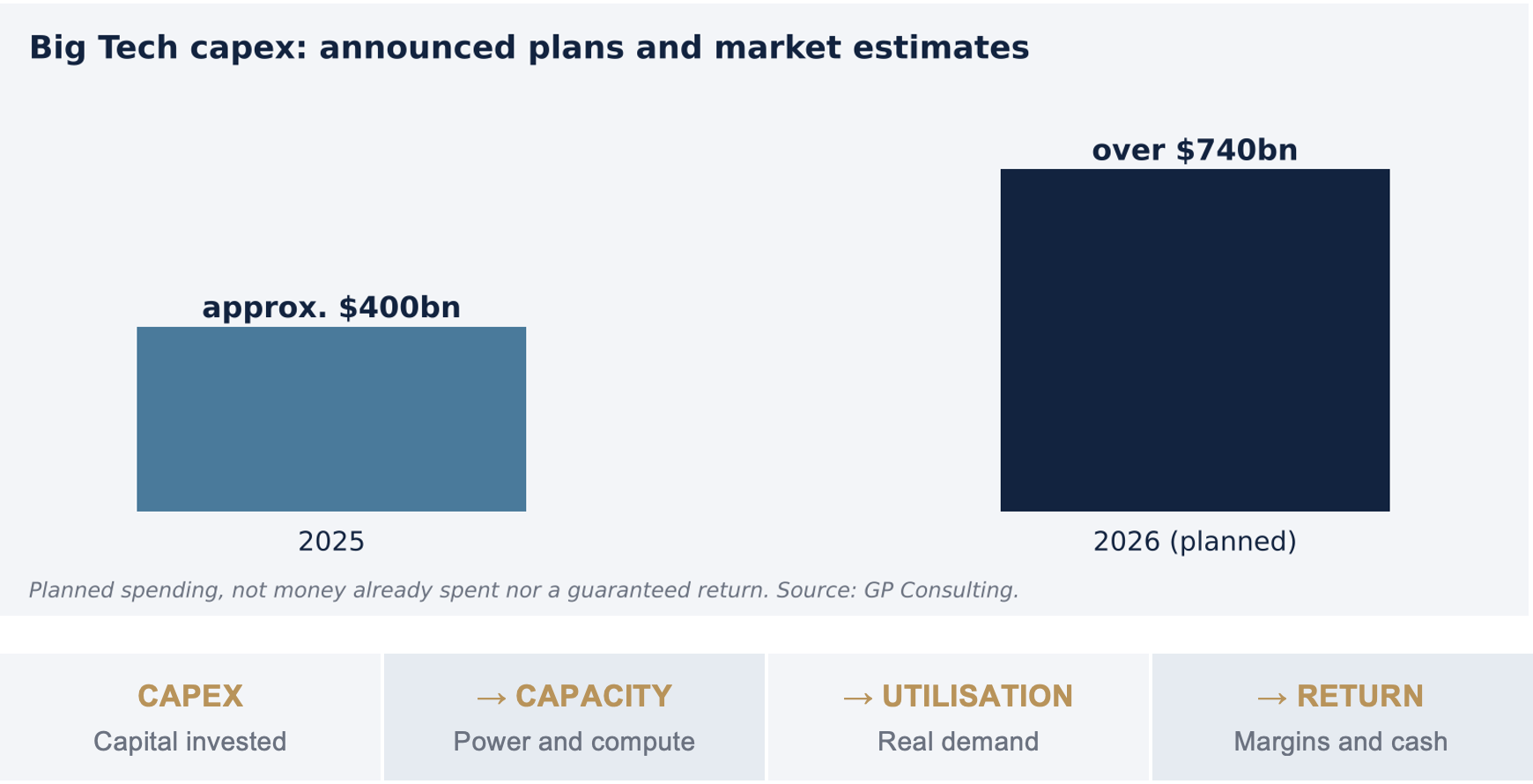
Building data centres is a highly capital-intensive industrial cycle. The large technology companies expect to invest more than $740 billion in 2026, compared with around $400 billion the previous year. The figure reflects announced spending plans and market estimates, not money already spent nor a guaranteed return. For investors, the central question is whether installed capacity will be used enough to cover depreciation, energy, financing and operating costs.
A restriction or delay can have opposite effects along the supply chain. For the large cloud operators, slower expansion may moderate spending growth and make existing capacity more valuable. For builders and suppliers, deferred orders can squeeze revenue before financing costs come down. For the wider economy, fewer construction sites can reduce demand for energy, materials, components and labour.
Financing deserves a precise reading. Microsoft has planned a bond issue of around $25 billion, its first major US dollar investment-grade raise in more than nine years. The company has said it expects positive free cash flow in the current financial year. The issue signals growing reliance on the credit market to fund investment and liquidity, but on its own it is not evidence of financial stress. It is important to distinguish between self-funding capacity, debt maturities and the expected return on new projects.
Energy and bonds amplified the reaction. After the vote, Brent fell by around 8-9% in Wednesday’s session, while the 10-year Treasury closed near 4.89%, down about six basis points, and the 30-year moved towards 5.28%. Weaker oil eases inflation risk and can support bonds, but the price reflects geopolitical expectations and does not guarantee a lasting fall in energy costs.
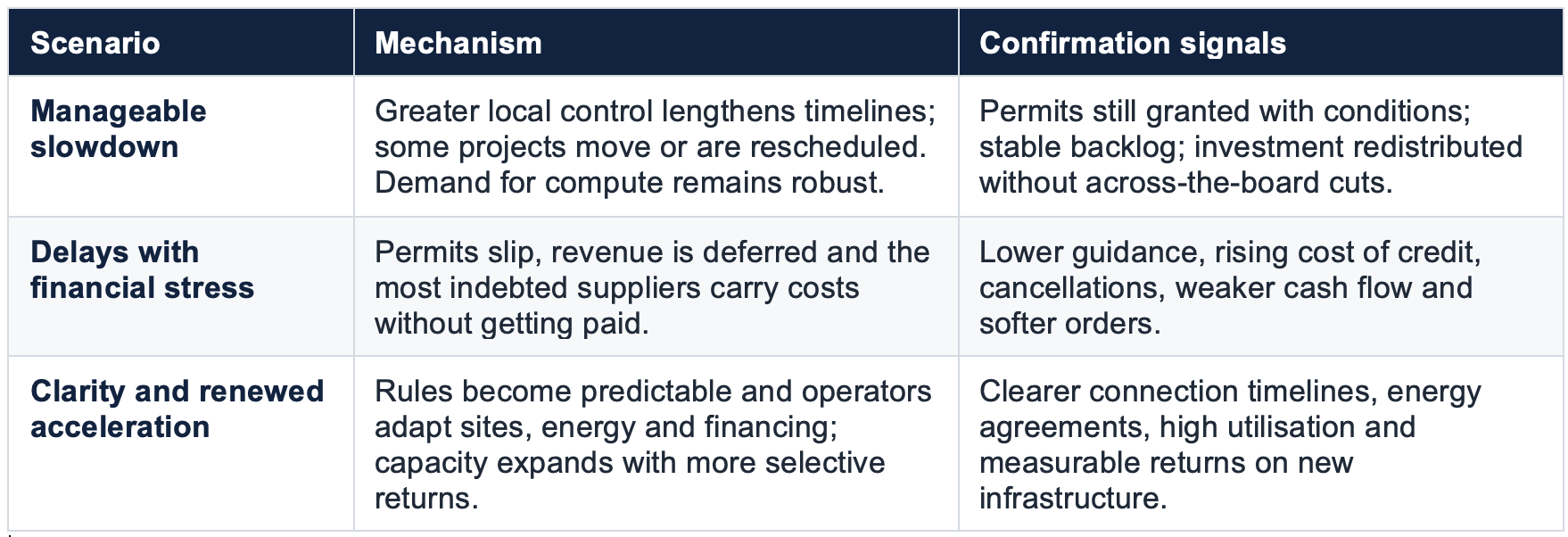
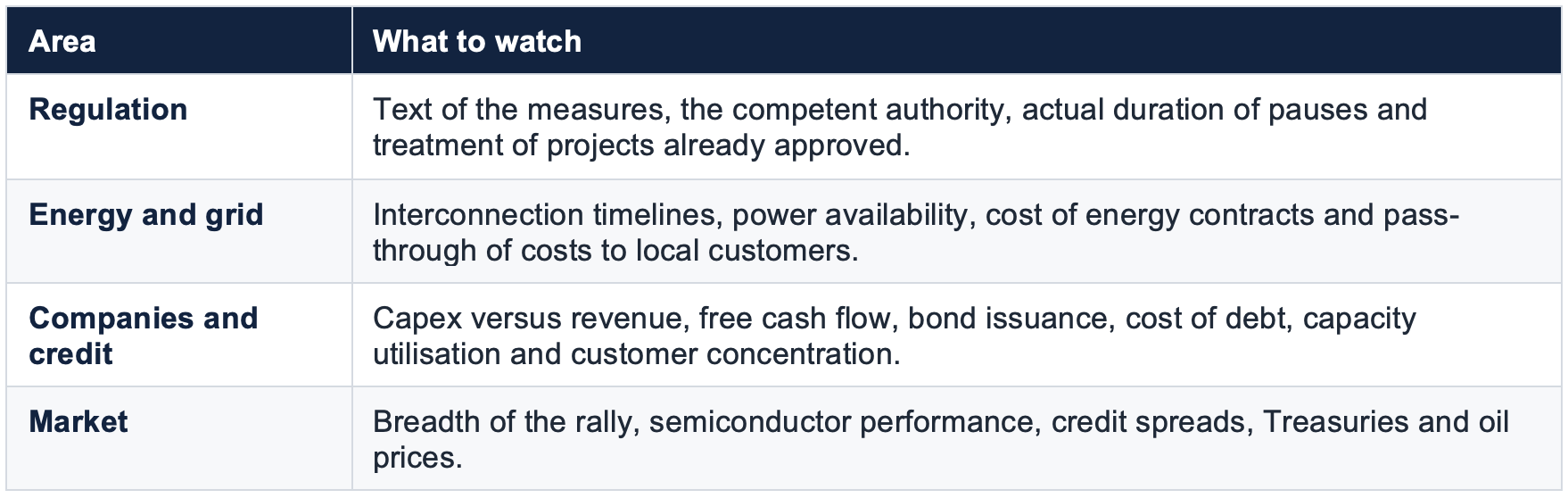
04 | Three scenarios and a monitoring grid
The variables that will separate these scenarios are more concrete than the political debate:
Conclusion | The vote changes the pace, not the bill
The session after the election showed a clear rotation: indices rose, but part of the AI supply chain lost ground. That is consistent with a market that places value on capacity already installed and asks for more proof from those financing new supply. The Democratic victory may make local rules and longer timelines more likely; it does not show that the AI cycle is over, nor that every project will be blocked.
The thesis remains conditional. If new rules slow construction without denting end demand, the winners and losers will differ from a scenario in which orders, monetisation and cash flow start to weaken together. That is why confirmation will not come from a single trading day, but from the sequence of permits, investment, utilisation and returns.
THE AUTHOR
Giancarlo Prisco is a financial analyst specialising in investment evaluation, financial strategy and corporate training. Operating across Europe and South America, he supports businesses with tailored financial solutions and training programmes designed to improve performance and drive sustainable growth.
Important note. This analysis is for information and educational purposes only. It does not constitute financial advice, a personal recommendation, or an offer or solicitation to buy or sell any financial instrument. Market data refers to US closes on 4 November 2026 and information available on 5 November 2026. Originally published in Italian by GP Consulting.
Your next step
Speak to an adviser
Tell us what you need. The JURIS team will review your enquiry and help you find the right support.