🇹🇷 Turkish Citizenship by Bank Deposit: An Alternative to Real Estate Investment?
Türkiye's Citizenship by Investment programme offers an alternative to traditional real estate investment: a USD 500,000 bank deposit held for three years. But what if the primary objective is not the financial return, but obtaining a second citizenship? Drawing on over a decade of experience in investment migration, this article examines the risks of property ownership, the potential benefits of bank deposits and three financial scenarios to explore the real economic cost of acquiring a Turkish passport.
JURIS Editorial
A $500,000 business case examining the real economic cost of acquiring a second citizenship.
Having worked in the Citizenship by Investment (CBI) industry for more than a decade, I have noticed that discussions often focus heavily on the financial performance of the underlying investment. How much will a property appreciate? What interest rate will the bank offer? How much capital will the investor recover after the mandatory holding period?
These are important questions, but I believe we should begin with a different consideration. In many cases, clients are not primarily looking to become property investors or purchase financial products. Their objective is to acquire a second citizenship, and the investment is simply the vehicle used to achieve it.
This distinction becomes particularly relevant when examining Türkiye's Citizenship by Investment programme and comparing the traditional real estate route with the alternative bank deposit option.
The Real Estate Experience and Its Often-Overlooked Risks
Türkiye allows foreign investors to apply for citizenship through a qualifying real estate investment of at least USD 400,000, subject to a three-year holding requirement.
Throughout my professional experience, I have encountered investors who were satisfied with obtaining Turkish citizenship but considerably less satisfied with the underlying property investment. Some experienced difficulties selling their apartments after the mandatory holding period, while others faced problematic tenants, unexpected maintenance expenses, high management costs or resale prices below their original acquisition costs.
In 2026, an even more serious issue emerged. According to figures reported by Türkiye's Ministry of Interior, the authorities cancelled investment conformity certificates relating to 1,150 principal investors following irregularities, including inflated property valuations and non-compliant documentation. The resulting cancellations of citizenship decisions affected 5,391 individuals, including family members. When additional cases involving national security and public order were included, the total reached 6,134 individuals.
It is important to clarify that these cases do not represent the Turkish real estate market as a whole, nor do they establish that every investor involved was aware of the alleged irregularities. However, they demonstrate the importance of verifying property valuations, transaction structures and regulatory compliance when purchasing real estate specifically to obtain citizenship.
Under certain circumstances, the consequences of an irregular investment may extend beyond financial losses and potentially affect the citizenship itself.
The $500,000 Bank Deposit Alternative
Turkish legislation provides another qualifying route: placing at least USD 500,000, or the equivalent permitted under the applicable regulations, in a Turkish bank and maintaining the qualifying investment for a minimum of 36 months.
This approach eliminates many of the operational complexities associated with real estate ownership. There is no apartment to purchase, no tenant to manage, no property maintenance and no need to find a buyer once the mandatory holding period expires. Instead, the investor maintains funds with a financial institution under the relevant banking and citizenship regulations.
Of course, this does not eliminate financial risk; it changes its nature. Rather than facing property-market and management risks, the investor must assess the bank's financial strength, potential exposure to the Turkish lira, taxation of interest income and contractual withdrawal conditions.
For someone whose primary objective is obtaining a Turkish passport, rather than owning property in Türkiye, this alternative deserves serious consideration.
Business Case: What Could a Second Citizenship Actually Cost?
To illustrate the financial implications, consider a hypothetical bank deposit of USD 500,000 converted into Turkish lira at an assumed initial exchange rate of 49.74 TRY per USD.
For this example, assume a fixed gross annual interest rate of 35% over 36 months, calculated on a simple-interest basis, with an illustrative 10% withholding tax on interest income.
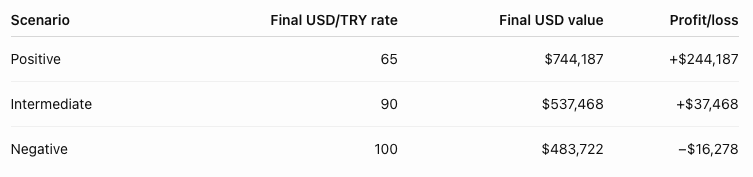
At the end of the three-year period, the original capital plus net interest would amount to approximately TRY 48.37 million. However, the final value in US dollars would depend entirely on the exchange rate at the time of conversion.
These scenarios are illustrative rather than forecasts. The assumed 35% interest rate is not a verified or guaranteed bank offer. The calculations exclude additional legal fees, banking charges and any other applicable taxes.
In the first scenario, the investor would have obtained citizenship while generating a financial profit of approximately USD 244,000. In the second, the investor would have recovered the original capital and earned approximately USD 37,000 in additional income.
The third scenario deserves a different perspective. Due to depreciation of the Turkish lira, the investor would recover approximately USD 483,722, representing a financial loss of USD 16,278, or 3.3% of the initial capital.
From a conventional investment perspective, this would be a negative outcome. However, assuming citizenship had been successfully granted, the investor would also have achieved the primary objective of the transaction.
Could that financial loss therefore be considered part of the effective economic cost of acquiring a second citizenship?
I believe it could, provided the investor fully understands the risks and considers them appropriate for their financial circumstances.
This does not mean that losses are insignificant or should be accepted without limits. The three scenarios do not cover every possible outcome. More substantial currency depreciation, banking difficulties or additional expenses could result in significantly greater losses.
Comparing Bank Deposits with Donation-Based CBI Programmes
This perspective becomes particularly interesting when comparing the bank deposit route with Citizenship by Investment programmes based on non-refundable government contributions, such as those offered by several Caribbean jurisdictions.
Under a donation-based programme, the qualifying contribution becomes a permanent expense once the citizenship process has been successfully completed. The applicant obtains citizenship but does not retain an underlying financial asset that can subsequently be liquidated.
Under Türkiye's bank deposit route, by contrast, the investor retains a financial asset that may be withdrawn following the required holding period, subject to the applicable terms. The financial outcome could be positive or negative, but there is an opportunity to recover a substantial portion, or potentially all, of the original capital.
This does not automatically make Turkish citizenship more attractive or cost-effective than Caribbean alternatives. Different citizenships provide different rights, mobility benefits, eligibility requirements and financial obligations.
Nevertheless, the comparison introduces an important consideration: the effective net cost of obtaining citizenship, rather than simply the amount initially committed.
One Question I Would Ask Before Recommending Real Estate
When a client considers purchasing property primarily to qualify for citizenship, I believe there is one particularly useful question to ask: "Would you still buy this apartment if it did not provide a pathway to citizenship?"
If the answer is yes, the property may represent a genuine investment opportunity with its own independent economic rationale. If the answer is no, it may be worth examining alternative qualifying structures that achieve the same citizenship objective without creating unwanted property ownership responsibilities.
The Turkish bank deposit route should therefore be assessed not only in terms of potential interest income but also in terms of its overall structure, administrative simplicity and suitability for the investor's objectives.
However, investors must also recognise that the Turkish lira may depreciate, deposit insurance protection is limited, and a high nominal interest rate does not guarantee a positive return in US dollars. Furthermore, citizenship approval remains subject to the relevant legal procedures, due diligence checks and governmental decisions.
Conclusion
Citizenship by Investment should not always be evaluated as a conventional financial investment. For many applicants, the primary motivation is to acquire another nationality, improve international mobility, create greater personal flexibility or provide additional opportunities for their families.
Real estate can be an excellent investment, but it may also become difficult to manage or sell. A non-refundable government contribution provides greater certainty regarding the initial cost, but the contribution cannot be recovered. A bank deposit introduces a different set of risks while offering the possibility of recovering capital and earning interest after the mandatory holding period.
After more than ten years in this industry, I believe the starting point should always be understanding what the client genuinely wants to achieve and identifying the most appropriate structure for their individual circumstances.
The passport is the objective. The investment is the vehicle used to achieve it.
And the real responsibility of an investment migration adviser is to identify which vehicle best aligns with the client's objectives, financial position and tolerance for risk.
Disclaimer: The financial scenarios presented are illustrative and do not constitute a banking offer, investment recommendation or guarantee of citizenship approval. Actual interest rates, taxation, banking conditions and legal requirements must be independently verified.
Your next step
Speak to an adviser
Tell us what you need. The JURIS team will review your enquiry and help you find the right support.