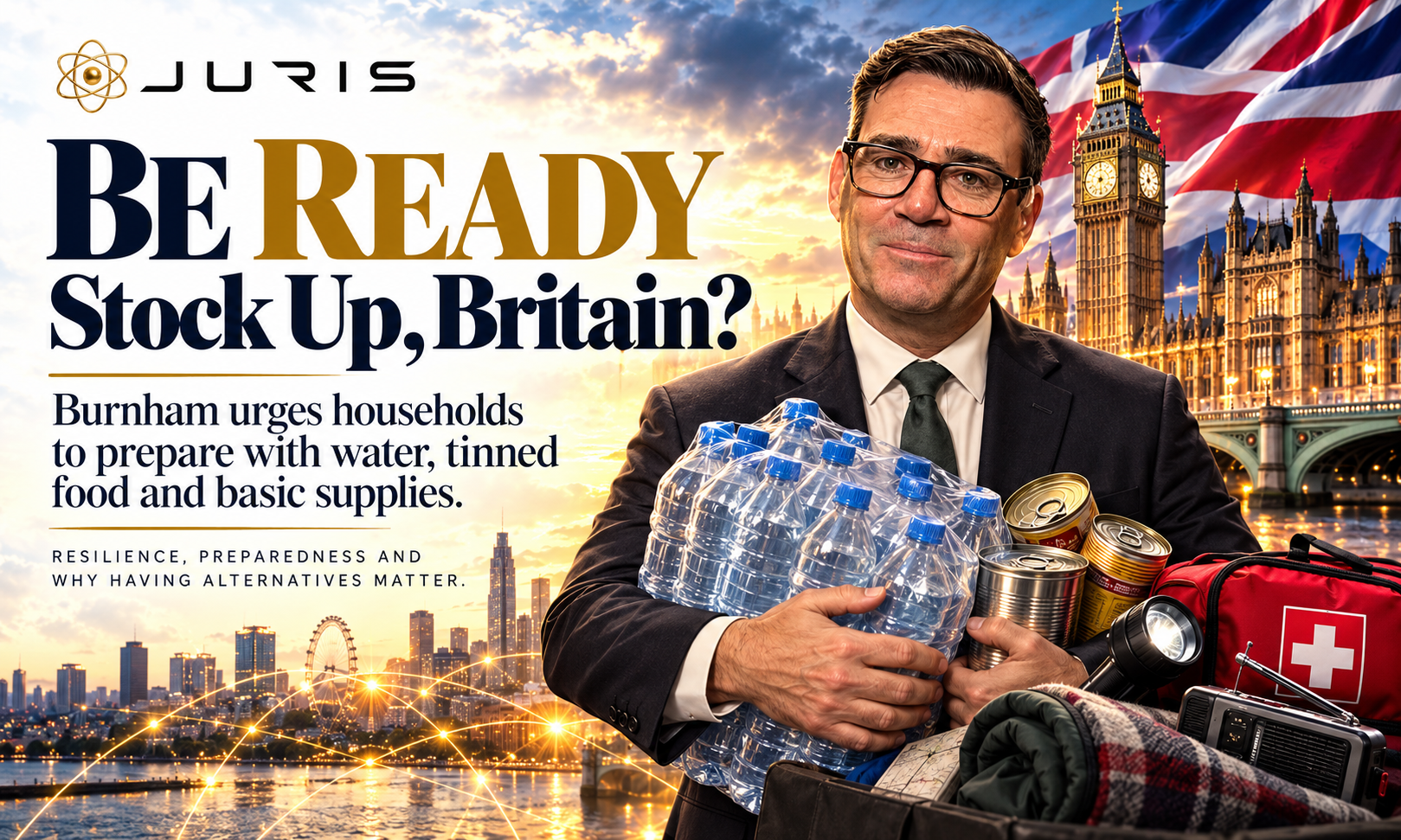
From emergency food supplies to alternative residencies and international banking, Europe's changing security environment is raising an important question: how prepared are we for the unexpected?
JURIS Editorial
On 23 October 2026, British Prime Minister Andy Burnham encouraged households to stock up on tinned food, bottled water and other essential supplies to prepare for potential emergencies.
The government's Be Ready campaign recommends keeping enough supplies to manage independently for at least 72 hours in case of power failures, cyberattacks, extreme weather or other disruptions.
But Britain is not alone.
Across Europe, governments have been delivering similar messages for years.
🇸🇪 Sweden (2018): Distributed its If Crisis or War Comes brochure, advising households how to prepare for emergencies and potential conflict.
🇳🇴 Norway (2024): Increased its recommended emergency supplies from three days to one week, citing growing security and infrastructure risks.
🇩🇰 Denmark (2024): Encouraged citizens to maintain three days of food, water and essential supplies.
🇪🇺 European Union (2025): Introduced its Preparedness Union Strategy, promoting at least 72 hours of individual self-sufficiency.
🇬🇧 United Kingdom (2026): Renewed public preparedness messaging amid concerns about cyber threats, extreme weather and infrastructure resilience.
These initiatives demonstrate a broader European shift towards greater civilian preparedness.
There is a significant difference between preparing for a potential emergency and expecting one to happen.
Britain had already introduced similar preparedness guidance in May 2024, while its 2025 Strategic Defence Review emphasised the importance of strengthening national resilience against geopolitical threats.
What is changing is the nature of the risks governments are asking people to consider.
Cyberattacks can disrupt banking systems. Extreme weather can interrupt electricity and transport. Geopolitical tensions can affect international travel, financial transactions and supply chains.
Modern societies are increasingly interconnected, but that interconnection also creates vulnerabilities.
The Hidden Risk of Depending on One Country
Most individuals rely on a single country for their residence, one banking system for their finances and one passport for international mobility.
Under normal circumstances, this may work perfectly well.
But what happens if a bank becomes temporarily inaccessible, international transfers are restricted or political circumstances suddenly change?
Recent disruptions to digital banking services have demonstrated that even when funds remain safe, accessing them is not always guaranteed.
The lesson is simple: having alternatives can reduce dependence on a single system.
Why International Diversification Matters
At JURIS, we believe preparedness should extend beyond keeping emergency supplies at home.
For internationally active individuals, entrepreneurs and families, a broader approach may include:
🌍 Alternative Residencies
A second legal residency can provide greater flexibility, allowing individuals and families to consider relocation or extended stays in another country when circumstances change.
🏦 International Banking
Maintaining accounts with multiple regulated institutions, potentially across different jurisdictions, can help reduce dependence on a single financial provider or banking infrastructure.
🛂 Second Citizenship
An additional citizenship can expand international mobility and provide alternative residence rights, depending on the countries involved and applicable restrictions.
💼 Geographic and Asset Diversification
Spreading legitimate business interests, investments and financial relationships across jurisdictions can help manage concentration risks, provided appropriate legal, tax and regulatory requirements are respected.
None of these solutions eliminates risk, and their suitability depends on individual circumstances.
However, properly structured, they can offer something increasingly valuable: options.
JURIS Global Perspective: The Value of Having a Plan B
There is an interesting parallel between governments encouraging citizens to prepare for emergencies and individuals developing an international Plan B.
Governments recommend keeping enough supplies to function independently when essential services are disrupted.
The same principle can apply to personal and financial planning.
An alternative residency provides another potential place to live. A second banking relationship offers another possible route to accessing funds. Additional citizenship may expand mobility rights.
The objective is not to predict the next crisis, but to avoid being entirely dependent on one country, one institution or one system.
As European governments increasingly encourage preparedness, perhaps it is time for internationally minded individuals to ask themselves a simple question:
If the systems you depend on today became unavailable tomorrow, what alternatives would you have?
Explore international residency, citizenship and cross-border planning opportunities at www.jurisglobal.org.
Disclaimer
This article is for general information purposes only and does not constitute legal, tax, financial or immigration advice. International residency, citizenship and banking arrangements are subject to applicable laws, regulations and individual circumstances. Professional advice should be sought before making decisions.
Your next step
Speak to an adviser
Tell us what you need. The JURIS team will review your enquiry and help you find the right support.