Dua Lipa, Flat Tax and a 26% Exit Tax: Is Milan Still the Answer?
Dua Lipa reportedly considering Milan, Italy's €300,000 Flat Tax, and a proposed 26% Exit Tax. But could Cyprus offer a smarter alternative? With its 60-day tax residency rule, Non-Dom benefits and international wealth planning opportunities, we explore why tax flexibility matters as much as tax savings.
JURIS Editorial
Dua Lipa to Milan: a tax decision too?
According to reports in the Italian press in October 2026, Dua Lipa is considering moving her residence from London to Milan, potentially from 2027.
The news has not been officially confirmed, but it has put the spotlight back on Italy's new residents regime, better known as the Flat Tax.
Under this regime, eligible individuals pay a fixed annual substitute tax on their foreign income, whatever the amount. For new arrivals the charge is currently €300,000 a year, for a maximum of 15 years.
An attractive opportunity for entrepreneurs, investors and international public figures.
But just as Italy competes for large fortunes, a new tax proposal could change the rules of the game.
Italy's proposed 26% exit tax
Italy's 2027 Budget Bill would extend exit tax to individuals who move their tax residence abroad. Article 17 was sent to the Chamber of Deputies on 30 October 2026 and, as drafted, would apply to transfers effective from 1 January 2027.
The measure, still under parliamentary discussion, would apply to individuals who:
have been Italian tax resident for at least six of the last ten tax periods;
hold assets and rights with a total value of at least
by moving abroad, cause Italy to lose the right to tax the related gains.
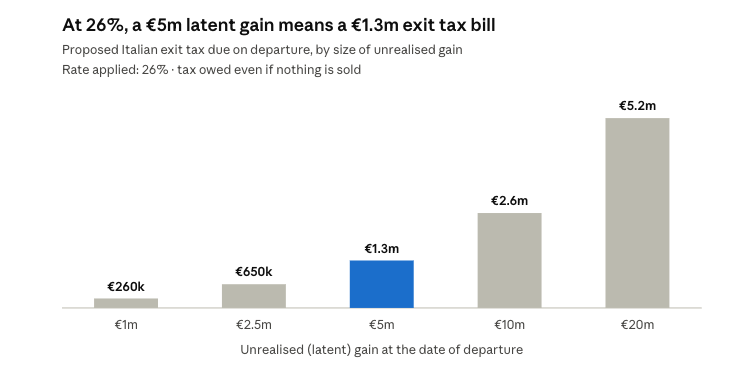
The rate would be 26%, charged on latent gains: gains accrued on investments that have not yet been sold.
Illustrative. Before any deferral, government bond base reduction or treaty relief.
The draft allows tax to be deferred until the gain is actually realised, and exempts individuals who return to Italy without having sold. Many technical points are left to an implementing ministerial decree, and coordination with existing preferential regimes is still unclear.
The real issue is for those who chose Italy trusting in the stability of its tax system.
The hypothetical Dua Lipa case
Imagine she does move her tax residence to Italy in 2027 and opts into the Flat Tax.
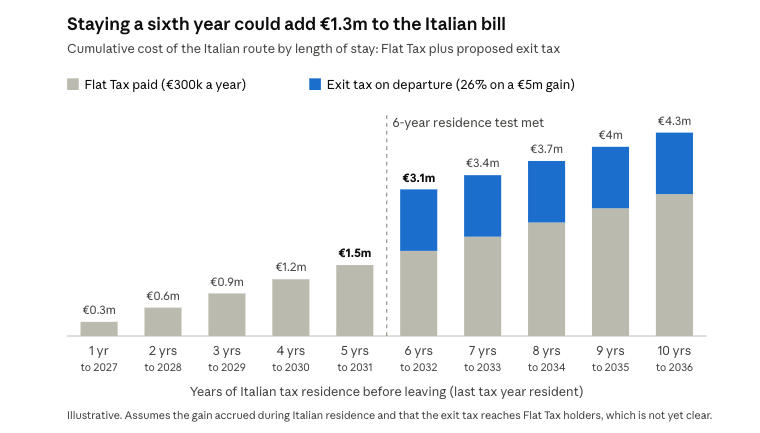
After six tax periods, 2027 to 2032, she could meet the time requirement in the exit tax proposal.
Assume, purely for illustration, an international artist holding financial investments with €5 million of taxable latent gains. At 26%, the theoretical tax would reach €1.3 million, even with no actual sale.
Illustrative. Assumes the gain accrued during Italian residence and that the exit tax reaches Flat Tax holders, which is not yet clear.
This is not an estimate of Dua Lipa's wealth or tax position. The example assumes every condition of the new rules is met.
The question is even more delicate for Flat Tax and impatriate regime beneficiaries: as drafted, the proposal does not appear to exclude them automatically.
Why Cyprus could be the more interesting alternative
If I were analysing the international tax planning of an artist with a profile like Dua Lipa's, I would certainly look at Cyprus. Not only for the tax, but above all for the flexibility of residence and the wealth planning opportunities.
Tax residence with 60 days
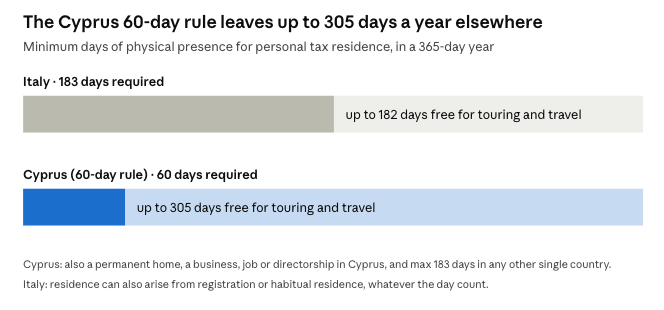
Under certain conditions, Cyprus grants personal tax residence with at least 60 days of presence a year. Further requirements apply: a permanent home in Cyprus, a qualifying economic link with the island, and no more than 183 days in any other single country. Since 1 January 2026, the condition of not being tax resident anywhere else has been removed.
For an artist constantly travelling for concerts, events and professional commitments, this flexibility could be a significant advantage.
Meeting the 60 days does not, of course, remove tax obligations in other jurisdictions. With the "not resident elsewhere" condition gone, dual residence and treaty tie-breaker rules need even closer attention.
The non-dom regime
Cyprus's non-dom regime can offer major advantages on dividends and interest, through an exemption from Special Defence Contribution for qualifying individuals, for up to 17 years. Since the 2026 reform, non-dom status can be extended beyond that for a fee of €250,000 per five-year block.
For people with company holdings and international investments, it can be a particularly useful tool. It does not mean, however, that all foreign income is automatically tax-free, and health system (GeSY) contributions still apply.
Music rights and the IP Box
For an artist like Dua Lipa, music rights and royalties are central.
Cyprus has an IP Box regime allowing an 80% deduction on profits from certain qualifying intellectual property. But be careful: traditional music copyright does not automatically fall within it. The regime mainly covers patents, copyrighted software and other specific categories of IP.
The strategy should therefore focus on licensing contracts, rights-holding companies, international withholding taxes and profit distributions, while meeting economic substance requirements.
JURIS Global Perspective | Alberto Rovere
After more than twelve years in international mobility, I believe good tax planning must consider not only the advantages of entering a country, but also the consequences of staying and of eventually leaving.
If I were assessing an international strategy for an artist with a profile like Dua Lipa's, I would analyse Cyprus before making a final decision on Italy.
The combination of flexible tax residence, the non-dom regime and corporate structuring options deserves a concrete look, especially for anyone with income and investments spread across several countries.
For someone coming from the United Kingdom, it would of course be essential to also check the end of UK tax residence, the relevant treaties and the treatment of artistic income.
The Italian exit tax proposal adds a further element to weigh up.
Italy has built an attractive system for drawing in capital and talent. However, introducing a tax on departure without clarifying the protections for those already in preferential regimes could reduce that appeal.
The six-tax-period requirement could even encourage some taxpayers to leave before reaching that threshold.
My position is simple: a country that wants to attract international capital must offer not only tax advantages, but also legislative stability and predictability.
International tax planning should always consider three moments: entry, stay and exit.
True tax freedom is not only choosing where to live today, but keeping the ability to decide where to live tomorrow.
Legal Disclaimer | Independent Editorial Analysis
This article is published for general information, educational and editorial purposes only. It reflects the independent views and opinions of Alberto Rovere, who is not a licensed tax advisor, accountant or legal practitioner. Neither the author nor JURIS Global provides tax or legal advice through this publication.
The information is based on publicly available sources and legislation or proposals available at the time of publication. Tax laws, residency requirements and regulatory interpretations may change without notice. No representation or warranty is made regarding the accuracy, completeness or continued validity of the information.
Any references to Dua Lipa are purely illustrative and based on publicly reported information. Her personal tax affairs, financial circumstances and residency intentions have not been independently verified. The hypothetical scenarios presented do not represent her actual financial or tax position. This publication is not affiliated with, sponsored by or endorsed by Dua Lipa or her representatives.
Readers should not rely on this article when making financial, tax, legal or residency decisions. Independent advice from appropriately qualified and licensed professionals in the relevant jurisdictions should always be obtained before taking any action.
Your next step
Speak to an adviser
Tell us what you need. The JURIS team will review your enquiry and help you find the right support.
International tax lawyer · Immigration & relocation specialist
Italy
Marco Mesina is an international tax lawyer and the founder of Studio Mesina and Move to Dolce Vita. With more than a decade of experience, he advises high-net-worth and ultra-high-net-worth individuals, family offices, entrepreneurs and internationally mobile families on tax, immigration, relocation and real estate.