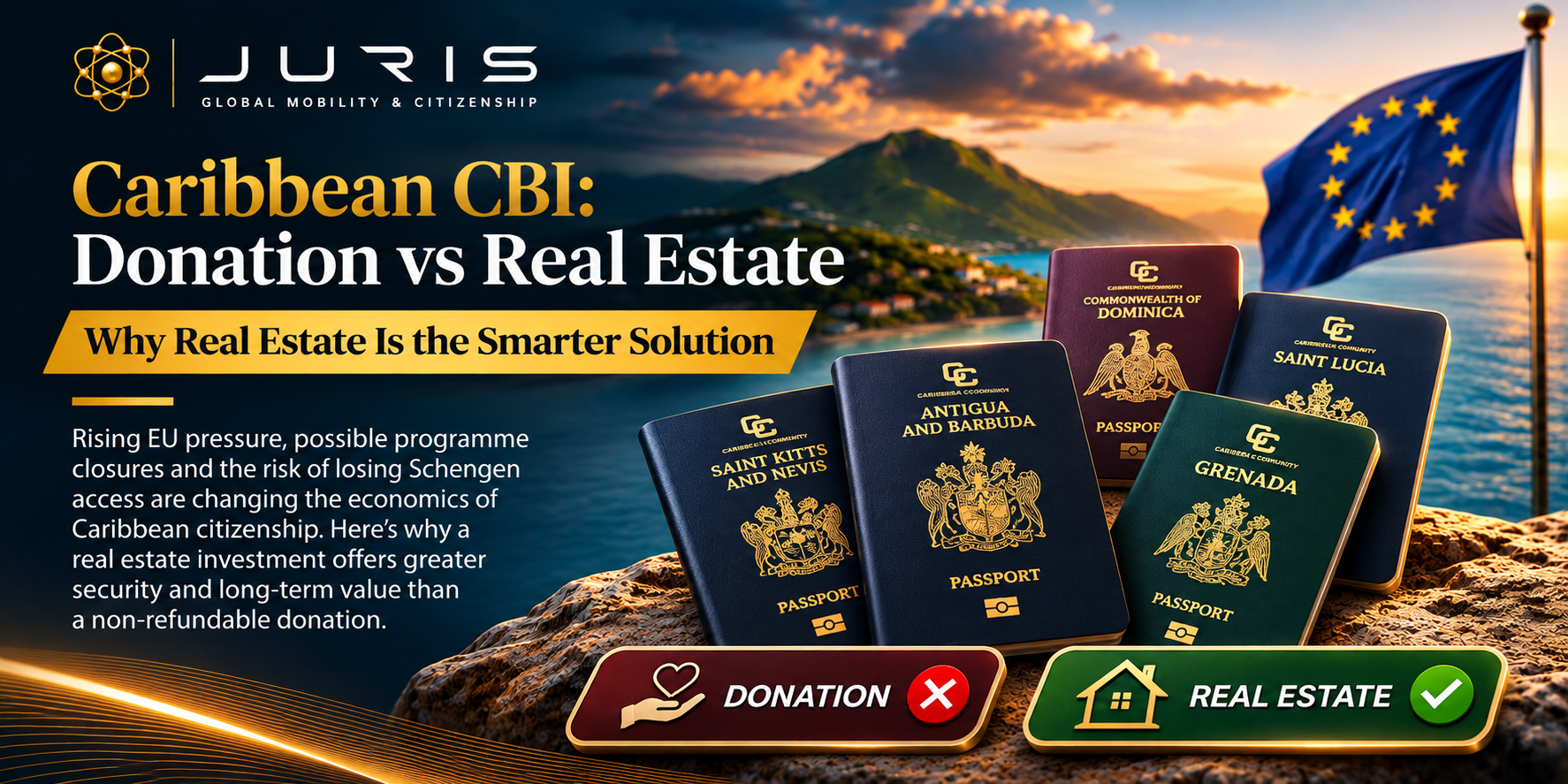
🇦🇬 🇩🇲 🇬🇩 🇰🇳 🇱🇨 Caribbean CBI: Why the Donation Option Is No Longer a Good Solution
Imagine paying USD 230,000 for a Caribbean passport.
A year later the EU removes Schengen visa-free access.
You still have the citizenship, but the main reason you paid is gone, and the money is gone forever.Donation-based programmes leave you with zero recovery.
Real estate at least leaves you with an asset you can sell.Would you still pay USD 230,000 for 125 destinations instead of 154?
JURIS Editorial
As Saint Kitts & Nevis begins phasing out its citizenship by investment programme and Antigua & Barbuda negotiates its future with Brussels, investors face a hard financial reality. Without Schengen visa-free access, a Caribbean passport loses much of the mobility advantage that justified its premium price.
Imagine paying USD 230,000 for a second citizenship today. You complete the application, pass due diligence, make a non-refundable government contribution and receive your passport.
A year later the European Union removes visa-free Schengen access. You still have the citizenship. The passport is still valid. But one of the main reasons you paid USD 230,000 has vanished, and the money is gone forever.
This is no longer theoretical. Recent developments in the Caribbean make the economics of pure donation increasingly difficult to justify.
Saint Kitts & Nevis and Antigua: A Clear Warning
On 13 November 2026, Prime Minister Terrance Drew announced that Saint Kitts & Nevis would gradually phase out its CBI programme (established in 1984). The programme continues during the transition, but no final deadline has been set.
Antigua & Barbuda has also signalled willingness to terminate its programme, subject to negotiations with the European Union over financial support and a transition period. Brussels wants a phase-out by June 2028; Antigua has proposed extending it to the end of 2030.
These moves follow Regulation (EU) 2025/2441, which strengthens the EU’s ability to suspend visa-free access for countries running investor citizenship schemes that lack a genuine link between applicant and state.
Neither country has automatically lost Schengen access yet. The direction of European policy, however, is unambiguous.
According to the Henley Passport Index 2026, Antigua & Barbuda currently offers access to approximately 154 destinations (including visa-on-arrival and eTA). Of these, 29 are Schengen countries.
If the EU suspended visa-free access across the entire Schengen Area, Antigua’s mobility score would fall from 154 to roughly 125 destinations, a drop of almost 19%.
The absolute number is secondary. What matters is that an investor may have paid USD 230,000 or more in non-refundable contributions. The nationality remains, but the mobility premium that justified the price can be substantially reduced.
What Happens to the USD 230,000?
Antigua’s National Development Fund route requires a minimum non-refundable contribution of USD 230,000 (excluding government fees, due diligence and professional costs).
If Schengen access disappears, the same passport is no longer worth anything close to that amount to most mobility-focused buyers. Even a conservative revaluation from USD 230,000 to USD 150,000 implies a 35% loss of perceived value.
Citizenship cannot be resold. There is no secondary market. The donation provides:
no capital to recover,
no resale opportunity,
no contractual protection against changes in visa policy.
The investor has paid a fixed, irreversible price for a benefit whose future utility depends on decisions made by foreign governments.
Why Real Estate Is the More Rational Choice
For investors who still want Caribbean citizenship, an approved real estate investment is financially more defensible than a pure donation.
In Antigua & Barbuda the minimum qualifying real estate investment is USD 300,000, subject to programme conditions and a five-year holding period.
Unlike a government donation, real estate can retain independent market value. If Schengen access is later removed, the investor still owns an asset that can potentially be sold.
This only works if the property is genuinely worth its purchase price. Some CBI-approved properties carry a significant premium simply because they qualify for citizenship. Paying USD 300,000 for an asset that would fetch only USD 180,000 on the open market is not necessarily better than a donation.
Before buying, investors should:
obtain an independent valuation,
examine actual comparable sales,
verify legal ownership and title,
assess realistic resale demand,
factor in maintenance, taxes, transaction costs and programme restrictions.
The decisive question is simple: Would I buy this property at the same price if it did not come with a passport?
If the answer is no, the investment requires much closer scrutiny.
A Passport Is Not a Financial Asset
Citizenship is a legal status, not a security with a quoted market price. It cannot be sold to recover the original outlay. It can still provide valuable rights, the ability to live in the country, consular protection, and (where permitted) transmission of nationality to future generations. Those benefits may remain even if Schengen access is lost.
Many CBI applicants, however, are motivated primarily by international mobility. For them, the economic case for a large non-refundable donation becomes much weaker once the travel advantages are significantly reduced.
This is why the distinction matters: the legal status may survive; the commercial attraction may not.
JURIS Perspective: Why Accept an Irreversible Risk?
The developments in Saint Kitts & Nevis and Antigua & Barbuda should serve as a clear warning to anyone considering a Caribbean CBI application in 2026.
The question is no longer simply which programme offers the most visa-free destinations today. It is whether those destinations, especially the Schengen Area, will remain accessible in the years ahead.
An investor who pays USD 230,000 through a donation assumes the entire financial cost immediately. If the passport later loses a substantial part of its mobility advantage, there is no mechanism to recover the contribution.
Real estate can offer a better structure, but only when the underlying asset has a credible independent valuation and realistic resale prospects.
The decision to acquire citizenship should rest on the investor’s actual needs, the stability of the programme, the future of international travel agreements, and the recoverability of any capital committed.
Would you still pay USD 230,000 for a passport if it offered access to 125 destinations instead of 154?
That is the question every prospective investor should answer before making an irreversible donation.
Your next step
Speak to an adviser
Tell us what you need. The JURIS team will review your enquiry and help you find the right support.