🇦🇬 Antigua's $500 Million CBI Dilemma: Can Europe Afford to Force Its Closure?
Antigua and Barbuda has proposed a conditional closure of its Citizenship by Investment Programme by 2030 as the EU threatens Schengen visa-free access. With over US$518 million generated since 2013 and 30 approved real estate projects, could the economic consequences of closure outweigh the benefits of retaining access to Europe?
JURIS Editorial
Antigua's $500 Million CBI Dilemma: Can Europe Afford to Force Its Closure?
As Antigua and Barbuda proposes a conditional closure of its Citizenship by Investment Programme by 2030, the European Union faces a complex question: what happens to a small island economy when one of its most important sources of foreign capital disappears?
The future of Antigua and Barbuda's Citizenship by Investment Programme (CBI) has entered a decisive phase.
The European Commission has asked five Eastern Caribbean nations to phase out their citizenship programmes by June 1, 2028, warning that their continued operation could result in the suspension of visa-free access to Europe's Schengen Area.
Antigua was originally given until November 12, 2026, to communicate its position. However, Prime Minister Gaston Browne has already responded.
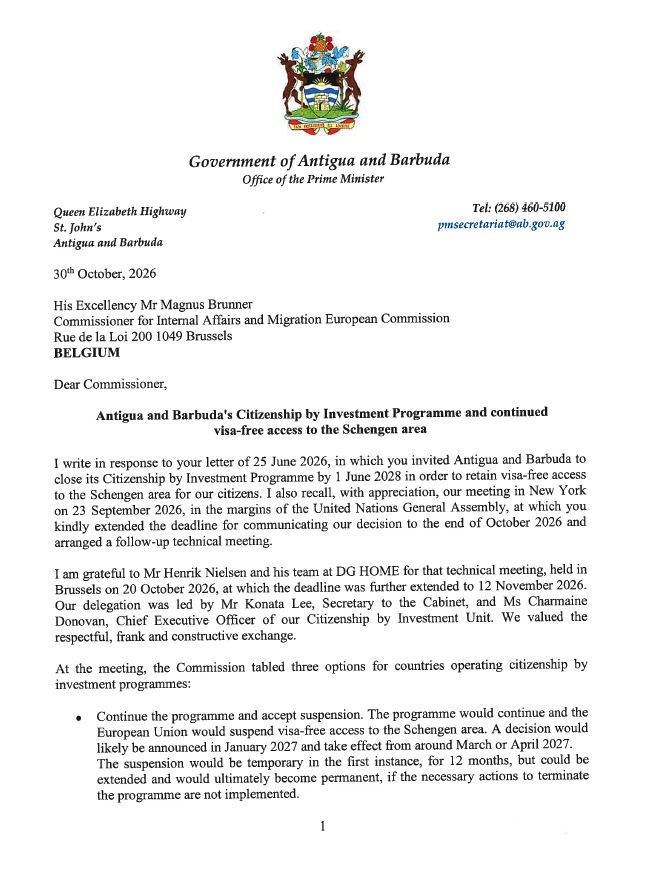
In a four-page letter dated October 30, addressed to European Commissioner Magnus Brunner, Browne confirmed that Antigua and Barbuda is prepared to terminate its programme, but only under a negotiated arrangement that includes a transition period until the end of 2030 and financial and technical assistance from the European Union.
1/4Official letter dated October 30, 2026, from Antigua and Barbuda's Prime Minister Gaston Browne to European Commissioner Magnus Brunner, outlining the government's position on the future of its Citizenship by Investment Programme. Source: Government of Antigua and Barbuda.
The government has also requested a comprehensive assessment of the economic, financial and social consequences of closure, to be completed by March 2027.
This is a significant development. Until recently, Antigua had publicly defended its CBI industry as an essential component of its economic strategy. The government's latest position represents a shift towards negotiating an orderly exit.
However, I believe the final outcome remains far from certain.
Having spent years working in the investment migration industry and living in Antigua, I understand how closely the country's economic development has become connected to international investment.
In my view, Antigua may find it extremely difficult to close the programme without substantial economic consequences. And should the European Union reject the proposed transition and financial arrangements, the possibility of maintaining the programme, even at the cost of Schengen visa-free access, cannot be entirely dismissed.
The real question is whether the economic cost of closure could ultimately outweigh the commercial and diplomatic value of retaining visa-free access to Europe.
A Programme That Has Generated More Than US$500 Million
Antigua and Barbuda launched its Citizenship by Investment Programme in 2013, with the first citizenship granted in 2014.
Since then, it has become a significant source of government revenue and international investment.
According to statements made by Prime Minister Browne in April 2026, the programme has generated more than EC$1.4 billion, equivalent to approximately US$518 million, in non-tax government revenue since its establishment.
This is a cumulative figure declared by the government, rather than an independently reconciled total of all historical programme receipts.
In 2025 alone, government CBI revenue was estimated at approximately EC$157 million, or US$58.1 million.
That amount was equivalent to approximately 2.6% of the country's nominal GDP. This ratio measures the scale of programme revenue relative to the economy, rather than its direct contribution to GDP.
For 2026, the International Monetary Fund projects approximately US$44.4 million in government CBI revenue.
These figures illustrate the fiscal significance of an industry that has become a recurring source of funding for the public sector.
The application statistics are equally important.
According to official Citizenship by Investment Unit reports, Antigua received 5,203 applications between the programme's inception and June 30, 2024.
European Commission data subsequently showed 1,733 applications received during 2024, compared with 685 in 2023.
Applications do not necessarily correspond to individual citizenships, as one application may include several family members.
The programme currently offers multiple investment options, including a minimum non-refundable contribution of US$230,000 to the National Development Fund and an approved real estate investment starting at US$300,000.
More importantly, the official CIU registry lists 30 approved real estate development entries, alongside a separate register of 11 approved business investment entries.
These are entries in the official registers, not necessarily 30 independent developers with active construction projects. Nevertheless, they demonstrate the scale of the property development sector connected to the programme.
And this is where, in my view, the greatest economic risk begins.
The Real Cost of Closure: Developers, Construction and Local Families
When discussing the termination of Citizenship by Investment programmes, the international debate tends to focus on government revenue and passport privileges.
What receives considerably less attention is the economic ecosystem built around these programmes.
Behind each approved real estate development are construction companies, architects, engineers, lawyers, suppliers, contractors, transport operators, hospitality professionals and small local businesses.
These activities support employment and generate commercial opportunities far beyond the initial investment transaction.
A sudden reduction in foreign capital could therefore place significant pressure on developers and potentially affect hundreds of Antiguan families whose livelihoods depend directly or indirectly on construction and tourism.
There is no comprehensive publicly verified figure for employment directly attributable to CBI, so the precise number of jobs at risk cannot yet be established.
However, this concern is no longer simply a matter of industry speculation.
In his October 30 letter to Brussels, Prime Minister Browne specifically identified the financial exposure of approved developers.
He explained that several projects are financed, wholly or partly, through the citizenship programme, and that their completion depends on investment that has not yet been received.
An accelerated closure could leave these projects unfinished and expose developers to significant contractual disputes and legal claims.
Browne also highlighted another important concern: the banking sector.
Domestic and regional financial institutions have provided financing to certain developments based on anticipated CBI-related investment receipts.
If these future revenues disappear, developers could struggle to repay existing financing arrangements, potentially creating problems for banks and other creditors.
Given Antigua's participation in the Eastern Caribbean Currency Union, the Prime Minister warned that financial pressures could extend beyond the country's borders.
This is an important distinction.
The consequences of closing a CBI programme cannot be measured solely by calculating the amount of money the government would no longer receive.
The broader impact could include delayed developments, lower construction activity, reduced demand for local services, potential banking exposure and weaker investor confidence.
Not every project would necessarily suffer. Some developments may already be completed, fully financed or commercially sustainable without CBI buyers.
Nevertheless, for those dependent on future citizenship-linked property sales, a sudden closure could fundamentally change their financing model.
In my assessment, replacing this investment channel would require time, new sources of capital and a credible long-term economic strategy.
Could Antigua Sacrifice Schengen Access Instead?
This brings us to a scenario that deserves more serious consideration.
What if Antigua ultimately decides that preserving its CBI industry is economically more important than maintaining visa-free access to Europe?
This is not the government's current preferred position. Browne has formally proposed a negotiated termination by 2030.
However, the October 30 letter confirms that continuing the programme while accepting the suspension of Schengen visa-free access was one of the three options discussed with European officials during the October 20 meeting in Brussels.
According to Browne's account, if Antigua chose this option, the European Union could announce a suspension in January 2027, with the restrictions potentially taking effect around March or April 2027.
The initial suspension could last twelve months and subsequently be extended or made permanent.
These dates remain indicative, not decisions already adopted by the EU.
The impact on the Antiguan passport would be substantial.
According to Henley & Partners, Antigua and Barbuda currently offers access to approximately 154 destinations without obtaining a visa in advance, under the index's methodology.
The Schengen Area includes 29 European countries.
If those 29 destinations were removed from the passport's existing mobility score, a simple calculation would reduce the total from 154 to approximately 125 destinations.
This is an illustrative scenario, not an official future passport ranking. The final figure would depend on the precise scope of the EU's restrictions and whether travel arrangements with other territories were affected.
Antigua would not technically withdraw from Schengen, since it is not a member. Instead, its nationals could lose the exemption that currently allows short visits without obtaining a Schengen visa.
For Antiguan citizens, including those who acquired nationality by birth rather than investment, this would represent a significant loss of travel convenience.
But from a commercial standpoint, another question arises.
How much would an Antiguan passport be worth to international investors without Schengen access?
The United States already imposes visa requirements on Antiguan citizens, and restrictions introduced on January 1, 2026, have suspended the issuance of new B-1/B-2 visitor visas to many applicants, subject to specific exceptions.
Consequently, a loss of Schengen access would further reduce the passport's appeal as an international mobility instrument.
The legal status and nationality rights associated with Antiguan citizenship would remain intact. However, the price investors are prepared to pay could fall significantly.
And this would create an additional competitive challenge.
Antigua Would Face Competition from Cheaper Citizenship Programmes
Antigua's current minimum National Development Fund contribution is US$230,000, excluding processing, due diligence and other applicable fees.
Without Schengen visa-free access, the programme could become less competitive against alternative citizenship routes.
Vanuatu offers a contribution-based citizenship programme with a published minimum programme payment starting at approximately US$130,000 for a single applicant.
Vanuatu has already lost its visa-free access to the European Union, providing a useful comparison of how a citizenship programme can continue operating without that travel benefit.
Nauru has emerged as another alternative.
Through its Iruwa Initiative, the country currently advertises a promotional contribution of US$90,000, excluding additional fees, for qualifying applications filed before December 31, 2026.
Its passport also does not provide visa-free entry to Schengen.
Türkiye represents a different investment proposition.
The Turkish citizenship framework permits qualifying foreign investors to acquire citizenship through a real estate purchase of at least US$400,000, subject to a three-year holding requirement, or through other eligible investment routes involving at least US$500,000.
Turkish citizens generally require a visa for short visits to Schengen.
However, the Turkish real estate route offers something fundamentally different from a non-refundable government contribution: ownership of an asset, with the possibility of retaining, using or eventually selling the property, subject to market and regulatory risks.
These programmes cannot be compared purely on price. Each provides different travel privileges, legal rights, investment structures and economic risks.
Nevertheless, the competitive implications are clear.
If Antigua loses Schengen access but maintains its current contribution threshold, its commercial proposition would become substantially more difficult to differentiate from lower-priced alternatives.
In my view, the country could eventually be forced to reconsider its pricing, investment options and broader positioning in the global citizenship market.
My Prediction: A Final Rush for Citizenship Applications
There is another scenario that I believe the market may be underestimating.
If Antigua ultimately agrees to terminate its CBI programme, with a definitive closure date and clearly defined transitional arrangements, we could witness a significant acceleration in applications during the final year of operation.
Investors who have been considering a second citizenship may view the deadline as their last opportunity to participate.
Assuming the government allows applications submitted before the closure date to continue being processed, demand could increase sharply as the deadline approaches.
I would not be surprised to see several thousand applications during a final transition window, particularly if the rules provide sufficient clarity for investors and licensed agents.
This is my personal market forecast, not an official projection.
Antigua received 1,733 applications in 2024, demonstrating the programme's ability to attract substantial annual demand.
However, the European Commission also reported just 78 applications during the first four months of 2025, highlighting how significantly market activity can fluctuate.
A final application surge is therefore plausible, but not guaranteed.
The precise transition arrangements would make an enormous difference.
A programme closing in June 2028 would create a very different commercial environment from one permitted to remain operational until December 2030.
There would also be several legal questions requiring clarification.
Would all applications submitted before the deadline remain eligible for processing? Would developers continue accepting qualifying investments? What would happen to approved applicants who had not yet completed their investment? And how would citizenships granted shortly before closure be treated?
Investors would need clear written answers before making financial commitments.
Crucially, obtaining Antiguan citizenship before a programme closes would not guarantee permanent visa-free access to Europe. That privilege depends on European visa policy, not merely on the date citizenship was granted.
A final application window could therefore create significant demand, but it would also require careful communication to avoid creating unrealistic expectations.
The European Union's Position Cannot Be Ignored
The European Commission's concerns extend beyond financial transparency or the quality of individual due diligence procedures.
Under the revised EU visa suspension mechanism, the operation of investor citizenship schemes without a genuine link between applicants and the issuing country can itself constitute grounds for suspending visa-free travel.
The Commission has raised concerns about security screening, the risk of applicants circumventing conventional visa procedures and the wider implications of granting citizenship primarily through financial investment.
These concerns deserve consideration.
The five Caribbean countries operating CBI programmes have introduced reforms, including enhanced due diligence procedures, information-sharing initiatives and harmonised minimum investment thresholds.
However, the European Union's position indicates that improvements in programme administration may no longer be sufficient to resolve the underlying regulatory disagreement.
This creates a difficult situation for Antigua.
The government must balance the international mobility rights of its citizens, its relationship with European partners and the potential economic consequences of terminating a major investment programme.
The challenge is not simply to decide whether CBI should continue.
It is to determine how the country could replace the revenues, investments and economic activity that might disappear if the programme ends.
The 2030 Proposal: A Compromise or the Beginning of the End?
Prime Minister Browne's October 30 letter provides the clearest indication yet of how Antigua intends to approach this challenge.
Rather than accepting the June 2028 closure deadline without conditions, the government has proposed a longer and more structured transition.
Its request includes a comprehensive economic impact assessment by March 2027, European technical assistance and a package of financial and development support proportionate to the losses associated with closure.
The government has also asked for such support to be considered within the European Union's next financial framework covering 2028 to 2034.
The logic behind this proposal is understandable.
If Antigua is expected to abandon a programme that has generated hundreds of millions of dollars and helped finance private developments, a transition should take account of existing financial commitments and the time needed to develop alternative sources of investment.
Yet important questions remain.
How much financial assistance would the European Union actually be prepared to provide?
Would it compensate only for lost government revenue, or also help address the potential impact on infrastructure, developers and employment?
And could any assistance package realistically replace the longer-term capital flows generated by international investors?
At present, none of these questions has a definitive answer.
The European Commission has not agreed to the requested 2030 deadline, and no specific compensation package has been confirmed.
The government's proposal should therefore be understood as a conditional negotiating position, not as a final agreement to terminate the programme on a legally established date.
My Outlook: Antigua May Not Be Ready to Walk Away
I believe the coming months will be decisive for the future of Antigua and Barbuda's Citizenship by Investment Programme.
The government's willingness to negotiate a closure by 2030 is an important development, but implementing that commitment will depend on the economic and political terms ultimately agreed with the European Union.
In my assessment, Antigua has strong reasons to seek the longest possible transition and substantial financial support.
The programme has contributed significant public revenue and supported investment in tourism, property development and infrastructure.
Its sudden termination could create financial pressures that extend well beyond the Citizenship by Investment Unit itself.
I therefore remain unconvinced that Antigua will necessarily close the programme within the original timeframe demanded by Brussels.
If the European Union rejects the proposed extension and fails to offer a financially workable transition, the government could face renewed pressure to reconsider its options.
At that point, continuing the CBI while accepting the loss of Schengen visa-free access could return to the discussion.
Such a decision would carry its own consequences, including weaker passport competitiveness, additional travel restrictions for Antiguan citizens and a possible decline in international investor demand.
Alternatively, if a negotiated closure becomes inevitable, I expect the final operating period to attract increased interest from investors seeking to apply before the deadline.
Either scenario would significantly reshape Antigua's position in the international citizenship market.
But the broader issue reaches far beyond passport sales.
For Antigua and Barbuda, the CBI programme has become part of an economic system involving government finances, property developers, financial institutions, construction businesses and local employment.
The question is not simply whether the country can operate without a Citizenship by Investment Programme.
It is whether the transition can be managed without creating an investment shortfall that takes years to replace.
And ultimately, is preserving visa-free access to 29 Schengen countries worth the potential loss of an industry that has generated more than half a billion US dollars in government revenue?
That is the economic dilemma Antigua now faces.
Analysis as of October 31, 2026. The cumulative revenue figure is based on statements by the Government of Antigua and Barbuda. Application statistics, approved developments and investment thresholds are drawn from CIU and European Commission publications. Future scenarios and market projections reflect the author's independent assessment and do not constitute confirmed government decisions.
Your next step
Speak to an adviser
Tell us what you need. The JURIS team will review your enquiry and help you find the right support.