Argentina’s New Citizenship-by-Investment Programme: Price Fixed, Schengen Question Open
Argentina has announced its new Citizenship by Investment programme, with routes starting at $350,000. We examine the legal framework, due diligence requirements and the key question: could the programme put Argentina’s visa-free access to Schengen at risk?
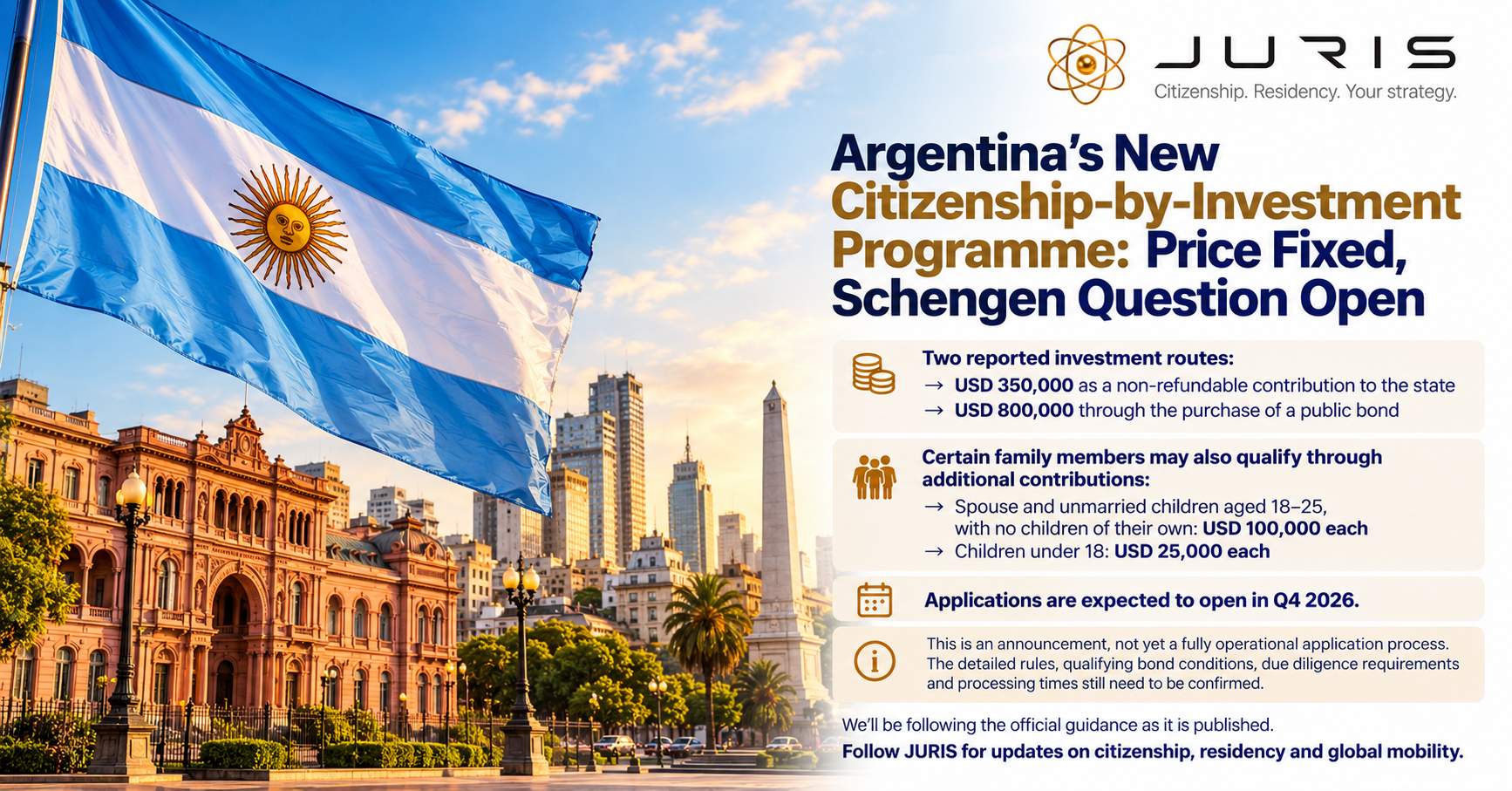
Argentina’s New Citizenship-by-Investment Programme: Price Fixed, Schengen Question Open
On October 2, 2026, on the last day of "Argentina Week" in Paris, Economy Minister Luis Caputo and Chief of Cabinet Diego Santilli presented a new citizenship by investment programme. Two channels, for now. A direct, non-refundable contribution to the National Treasury of $350,000, or the purchase of public bonds created specifically for the programme, at zero interest, for $800,000. Caputo linked the initiative to the government's international opening process; Argentine press reports attribute to him a reference to due diligence, financial transparency and risk management standards in line with OECD and FATF recommendations, but I have not found a full transcript of the statement that confirms this word for word. Of Santilli's remarks, only the fragment quoted by the press is confirmed, "This is the Argentina that opens its arms," referring to the years when the country "was great".
The Family Unit Has Its Own Price Tag
The programme includes additional contributions for family members accompanying the main applicant. A spouse and unmarried children aged 18 to 25 with no children of their own cost $100,000 each. Children under 18, $25,000 each. A typical family, applicant plus spouse plus two minor children, comes to exactly $500,000 in total (350,000 plus 100,000 plus 25,000 plus 25,000): this is the example the government itself gave at the press conference, not just a press calculation. One point remains open: it is not clear, in the details published so far, whether these same family quotas also apply to those who choose the $800,000 public bond route, or only to the $350,000 direct contribution route. I flag this as a question to verify, not as an established fact.
Who Decides, and With What Controls
The administrative framework is already in place. DNU 366/2025 created the Investment Citizenship Programmes Agency, while Decree 524/2025 regulates the procedure. The Agency evaluates applications, with Migration making the final decision within 30 business days. Due diligence covers identity, source of funds, financial position, country risk, criminal and reputational checks, and migration history. In short, the legal framework was already established. What was missing until now were the investment amounts.