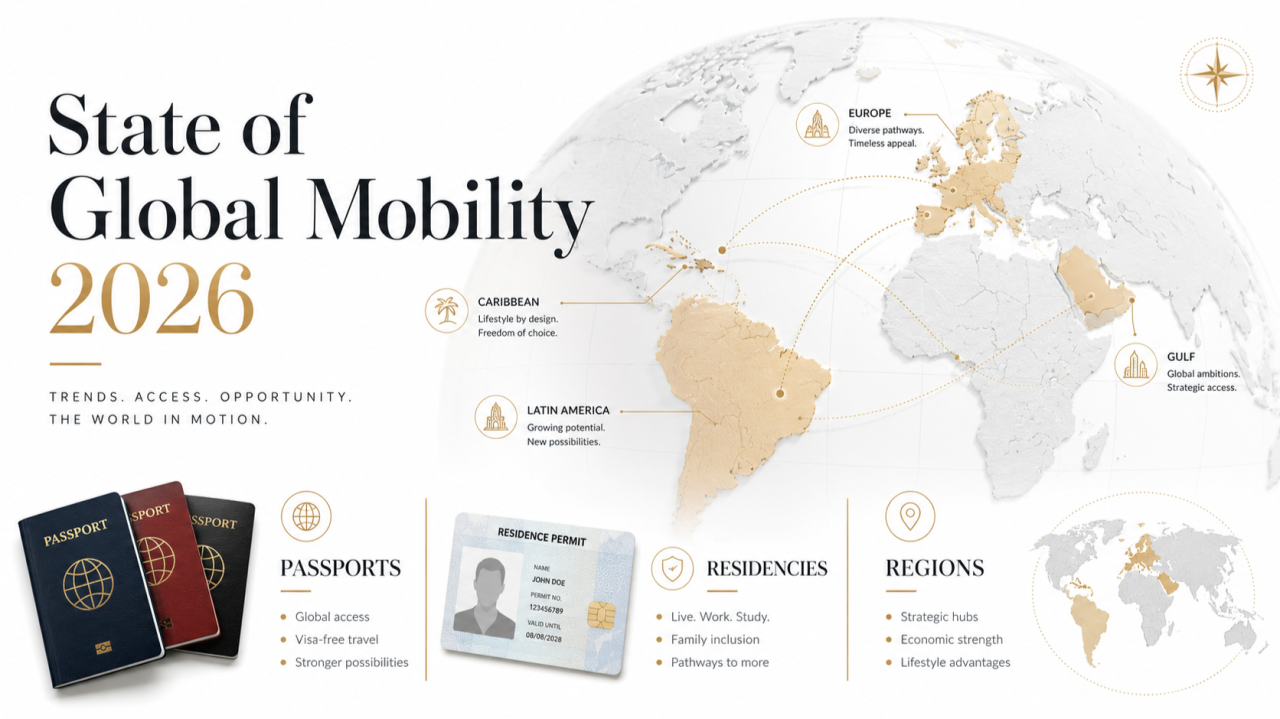
Citizenship, residency, capital, and the new geography of personal sovereignty. A 2026 assessment of regulatory pressure, wealth migration, banking compatibility, and layered jurisdictional planning.
Carlo Alberto Rovere IMCM, ICWIM
For two decades, global mobility was measured in a single number: how many countries a passport could enter without a visa. That measure is no longer sufficient. In 2026, mobility has become a composite condition, built from residency rights, tax residence, banking access, capital mobility and political optionality, layered across jurisdictions rather than concentrated in one.
This report examines that shift. It analyses the regulatory pressure now facing citizenship by investment, the rise of residency as the more durable planning tool, the growing weight of banking compatibility, and the geopolitical forces reshaping how internationally mobile families and entrepreneurs think about where they belong, where they live, and where their capital operates.
01 Executive Summary
Nine findings define the state of global mobility in 2026. Together they describe an industry moving from a transactional product sold on passport strength toward a strategic discipline built on layered, jurisdiction-spanning optionality.
Citizenship by investment has entered its most consequential regulatory period.The European Commission's revised Visa Suspension Mechanism now treats the operation of an investor citizenship programme as sufficient grounds, by itself, to suspend Schengen visa-free access. Five Eastern Caribbean states have been given until June 2028 to end their programmes or accept that risk, marking the first time programme existence rather than programme conduct has become the regulatory trigger. In my view,
For most mobile families, residency has superseded citizenship as the core instrument of jurisdictional planning. As citizenship-by-investment routes narrow, lengthen and attract greater political scrutiny, residency programmes, both investment-based and non-investment, have become the more durable and lower-risk path to optionality, nowhere more clearly than across the Gulf and selected Latin American jurisdictions.
Millionaire migration has reached a new record and shows no sign of plateauing.Henley & Partners recorded 142,000 millionaire relocations in 2025, the highest figure on record, with a 2026 forecast of up to 165,000. The pattern is now structural rather than a post-pandemic correction.
The advisory conversation has shifted from relocation to portfolio construction.H&P' 2026 methodology change, replacing simple inflow and outflow forecasts with a twelve-dimension Global Wealth Mobility Framework, reflects a broader industry recognition that wealthy families increasingly build sovereign portfolios of residence rights, citizenships and business interests rather than executing single relocations.
Golden visas have been decoupled from real estate across most of Europe.Portugal eliminated the real estate route in October 2023; Spain terminated its programme entirely in April 2025; Greece has tripled thresholds in its most desirable zones. Capital is now steered toward funds, business creation and productive investment rather than housing.
Banking access, not passport or residence status, is becoming the binding constraint on mobility planning. Financial institution de-risking, source of funds scrutiny and nationality-based risk scoring mean that a valid residence permit or second passport no longer guarantees the ability to open or retain a bank account. Compatibility with the global banking system is now a prerequisite for any mobility strategy, not an afterthought.
Tax transparency has made relocation legally simpler and administratively harder in the same motion.With 173 jurisdictions now participating in the OECD Global Forum's transparency framework and well over one hundred exchanging account data automatically under the Common Reporting Standard, moving one's residence has become easier to execute and far harder to obscure from any single tax authority.
Ultra-high-net-worth populations are growing faster than the infrastructure built to serve them.Knight Frank recorded a rise in the global population holding US$30 million or more in net assets from 551,435 in 2021 to 713,626 in 2026, a 29 percent increase in five years, while UBS found that 36 percent of billionaires relocated at least once in 2025.
02 The Global Mobility Reset
For most of the last thirty years, mobility was ranked on a single axis: how many destinations a passport could reach without a prior visa. That axis still matters, but it now describes only one dimension of a more complex condition.
The travel-freedom ranking model emerged from a genuinely useful idea: passports differ enormously in the access they confer, and that access can be measured.
But travel freedom answers only one question: can a person visit a place. It says nothing about whether they can live there, whether their assets are taxed there, whether they can bank there, or whether the jurisdiction itself remains politically and regulatorily stable enough to rely on over a decade. Sophisticated mobility planning in 2026 increasingly separates these questions rather than collapsing them into a single passport ranking.
I have analysed global mobility across five interacting dimensions, each answering a distinct question that the old passport model conflated:
03 Global Mobility in Numbers
The scale of global human movement, and of wealth migration specifically, continues to expand. The figures below are drawn from primary multilateral sources and leading wealth-migration research, with methodological caveats noted where projections rather than census data are involved.
04 Citizenship by Investment: A Sector Under Pressure
Citizenship by investment is entering the most consequential period of regulatory scrutiny in its four-decade history. The direction of travel is consistent: higher thresholds, deeper due diligence, and an increasingly explicit European position that programme existence itself, not merely programme conduct, is a legitimate ground for restricting the value of the passports these programmes produce.
The European ultimatum
In its eighth report under the Visa Suspension Mechanism, published in December 2025, the European Commission shifted its position from treating citizenship by investment as a risk factor requiring mitigation to characterising the operation of such programmes as grounds for suspension in itself. By mid-2026 this had translated into a formal timeline: five Eastern Caribbean states, Antigua and Barbuda, Dominica, Grenada, Saint Kitts and Nevis, and Saint Lucia, were told they must end their programmes by 1 June 2028 or risk losing Schengen visa-free access for their citizens. Interim milestones, including the exclusion of sanctioned applicants and enhanced due diligence for all nationalities, were set for September 2026.
The five governments responded jointly in July 2026, coordinating a diplomatic mission to Brussels while declining to announce programme closures. Approximately 107,000 passports have been issued across the five Caribbean programmes to date, with application volumes exceeding 10,000 to 13,000 per year in recent years, underscoring the fiscal stakes for economies where these programmes contribute a meaningful share of government revenue.
A pattern, not an isolated case
The Caribbean is not the first jurisdiction to face this pressure. Vanuatu's EU visa waiver was suspended in 2022 over due diligence failures, restored, and suspended again in 2024. Malta's citizenship by investment scheme was ruled unlawful by the European Court of Justice in April 2025, which found that Union citizenship cannot be the product of a purely commercial transaction, effectively closing the pure cash-for-passport route within the EU itself. Newer entrants, including São Tomé and Príncipe, which launched a programme in August 2025, and other African and Pacific jurisdictions, are entering the market largely because established routes have become more expensive, slower, or politically exposed.
From passport product to strategic citizenship
The commercial framing of citizenship by investment as a straightforward product, a fixed price for a fixed set of travel rights, is becoming harder to sustain. Programmes now compete less on headline cost and more on regulatory durability: due diligence architecture, the credibility of source-of-funds screening, and the likelihood that visa-free access will still exist in ten years. This report treats citizenship by investment as one input into a broader strategy rather than a terminal objective, and does not present any programme as inherently superior; each carries a distinct risk profile that changes as EU, UK, US and FATF positions evolve.
Analytical note. This section describes publicly reported regulatory developments as of August 2026. It is not an endorsement or criticism of any government or programme, and it does not constitute legal, immigration, or investment advice. Programme rules and EU positions are subject to change; applicants should confirm current requirements with official government sources before proceeding.
05 Residency by Investment: The New Centre of Gravity
As citizenship programmes narrow, residency has become the more resilient instrument for most internationally mobile families, offering many of the practical benefits of citizenship, the right to live, work and often eventually naturalise, without the acute political exposure now attached to investor passports.
Europe's fund-led pivot
Portugal removed real estate as a qualifying investment under its October 2023 housing reform, leaving fund subscriptions at €500,000, cultural investment at €250,000, and job-creation routes as the principal channels; a backlog exceeding 20,000 applicants and processing times averaging close to forty months illustrate the administrative strain of the transition. A May 2026 nationality law reform further lengthened the naturalisation timeline for most applicants from five to ten years. Greece has taken a different approach, retaining real estate but tripling thresholds in its most sought-after zones to €800,000 while leaving lower tiers available elsewhere, alongside new restrictions on short-term rental use of qualifying property.
Spain terminated its golden visa entirely in April 2025. Ireland and the UK closed their investor routes in 2023 and 2022 respectively. Of the European programmes still active in 2026, the durable ones share a common feature: they direct capital toward funds, business formation or research rather than housing stock.
The Gulf's advantage but not only
The UAE’s Golden Visa remains a leading option for globally mobile wealth, combining long-term residency with zero personal income tax, no capital gains or inheritance tax on personal assets, and no minimum stay requirement. Saudi Arabia is also expanding rapidly through its Premium Residency framework, using investment, entrepreneurship and real estate to attract international capital under Vision 2030.
However, the Gulf’s structural advantage should also be assessed against its geopolitical exposure. Regional conflicts, sanctions, airspace disruption and broader security tensions can create indirect risks even for jurisdictions that remain politically stable and economically resilient. For globally mobile families, this reinforces the importance of geographic diversification rather than relying on a single residency or wealth hub.
Europe therefore remains highly relevant despite tighter rules. Italy combines its Investor Visa with a €300,000 flat-tax regime on foreign-source income for new residents from 2026. Switzerland continues to attract wealth through stability, selective residency and lump-sum taxation, while Gibraltar offers dedicated HNW and executive regimes. Cyprus remains competitive through permanent residency from €300,000 and its non-domiciled tax framework.
Latin America is also gaining attention. Paraguay offers direct permanent residency through investment routes alongside territorial taxation and 0% tax on foreign-source income. Panama combines investment-based residency, a dollarised economy, established banking infrastructure and territorial taxation.
A taxonomy of residency routes
Not all residency by investment serves the same purpose, and conflating them leads to poor planning decisions. This report distinguishes six broad categories that recur across jurisdictions: investment residency tied to a specific financial contribution; financially-independent residency requiring only proof of means; entrepreneur residency tied to active business formation; tax-driven residency chosen primarily for its fiscal terms; retirement residency aimed at passive-income individuals; and residency structured explicitly as a multi-year path to eventual citizenship. A single jurisdiction may offer several of these routes simultaneously, and the right choice depends on the family's underlying objective rather than on programme popularity.
Within this taxonomy, Paraguay has gained particular attention as a practical, lower-threshold option in Latin America. Its residency routes typically require modest capital or business activity, impose limited physical-presence obligations, and operate under a territorial tax system that does not tax foreign-source income. For many applicants seeking genuine optionality rather than a European lifestyle base, it functions as a cost-effective complementary jurisdiction rather than a primary relocation destination.
06 Tax Residency and the Mobility Economy
Tax residence has become as central to mobility planning as travel freedom or the right to live somewhere. A residence permit or second passport carries limited strategic value if it is not paired with a clear, defensible tax position.
Jurisdictions compete for mobile capital through a range of fiscal architectures: territorial taxation regimes that exempt foreign-source income entirely; remittance-basis systems that tax only income brought into the country; lump-sum or forfait arrangements common in parts of Switzerland; flat-tax regimes aimed at high earners, including Italy’s new-resident regime; and targeted incentives for pensioners, such as Greece’s 7 percent flat rate on qualifying foreign pension income.
Paraguay is increasingly relevant for those seeking a comparatively simple fiscal-residency base, combining territorial taxation with no tax on foreign-source income and relatively limited physical-presence requirements. Cyprus offers a different model: its non-domiciled regime can significantly reduce taxation on certain investment income while preserving an EU-based residence framework. Panama also remains attractive through its territorial tax system, dollarised economy and established international banking infrastructure.
Digital nomad visas, largely absent a decade ago, now exist in dozens of countries and increasingly carry their own tax treatment distinct from standard residency.
Substance requirements have tightened across the jurisdictions most commonly used for tax planning. Authorities increasingly expect genuine economic presence, real property, time physically spent in the country, local banking relationships, rather than a nominal registration. This trend runs parallel to, and reinforces, the transparency architecture discussed in the next section.
Important disclaimer. Tax outcomes depend entirely on an individual's personal circumstances, the interaction between their existing tax residencies, applicable double-taxation treaties, and the domestic law of every jurisdiction involved. Nothing in this section constitutes tax advice. Anyone considering a change of tax residence should engage a qualified tax adviser licensed in the relevant jurisdictions before acting.
07 The Geopolitics of Mobility
Mobility planning can no longer be separated from geopolitics. Sanctions regimes, great-power tensions and regional instability now shape which jurisdictions are viable for a mobility strategy as much as tax rates or processing times do.
Russia-related sanctions since 2022 removed several previously popular jurisdictions from consideration for a large pool of applicants and prompted heightened scrutiny of the source of funds for Russian nationals across virtually every programme worldwide. US-China tensions have accelerated interest in jurisdictional diversification among mainland Chinese and Hong Kong-based investors, a trend visible in Henley & Partners' regional demand data. Middle East instability has, somewhat counterintuitively, reinforced rather than diminished the appeal of Gulf residency, with Henley describing recent UAE-based activity as contingency planning and diversification among residents adding second residences elsewhere rather than an exodus from the Emirates.
The concept of jurisdictional hedging, holding residence rights, banking relationships and, where possible, citizenship across more than one geopolitical bloc, has moved from a niche concern of politically exposed individuals to a mainstream consideration for entrepreneurs and family offices. A single-jurisdiction strategy, however favourable its terms, now carries a concentration risk that a diversified structure does not.
08 Banking Access: The Hidden Dimension of Mobility
A passport or a residence permit is not, on its own, a guarantee of banking access. This is the dimension of mobility planning most frequently underestimated, and increasingly the one that determines whether a strategy is workable in practice.
Financial institutions apply their own independent risk assessment regardless of a client's immigration status. Even UAE Golden Visa holders, whose status is treated favourably by banks in that jurisdiction, are still subject to full source-of-funds and income-transparency review; a valid visa is a positive signal, not an approval guarantee. Nationality risk, residency risk, correspondent banking constraints and outright de-risking, where institutions decline entire categories of client to reduce compliance burden, have made banking compatibility a gating factor rather than a formality.
Politically exposed persons, nationals of sanctioned states, and individuals whose wealth originates from jurisdictions perceived as high-risk face materially higher friction opening and maintaining accounts, irrespective of the legitimacy of their funds. This friction has intensified as banks respond to their own regulators' expectations under anti-money-laundering and counter-terrorism-financing frameworks.
The practical implication is that mobility planning must sequence banking considerations before, not after, choosing a citizenship or residency jurisdiction. A programme that delivers an attractive passport or residence permit but leaves the holder unable to open a compliant bank account anywhere outside that single jurisdiction has not solved the underlying problem; it has relocated it.
09 CRS, Tax Transparency and Financial Visibility
Automatic exchange of financial account information has fundamentally changed what relocation can and cannot achieve. Moving one's residence no longer means becoming invisible to tax authorities; in most cases it means becoming visible to a different one, on a predictable annual schedule.
The Common Reporting Standard, developed by the OECD and modelled in part on the US Foreign Account Tax Compliance Act, now involves well over one hundred participating jurisdictions exchanging financial account data automatically each year. Coverage has expanded steadily; Georgia, Kenya, Moldova and Ukraine began their first exchanges in 2024, with further jurisdictions committed through 2027. The OECD's broader Global Forum on transparency and exchange of information now counts 173 member jurisdictions engaged in peer review of these standards.
The practical consequence for mobility planning is straightforward: financial institutions collect tax residency self-certifications and report account information to the tax authority of record. Beneficial ownership transparency registers, economic substance requirements, and FATCA's continuing reach for US persons abroad compound this visibility. A small number of jurisdictions remain outside the CRS network, but their number continues to shrink, and reliance on non-participation as a planning strategy carries growing legal and reputational risk rather than offering durable protection.
10 Mobility Archetypes
Mobility strategy is not one-size-fits-all. The six profiles below illustrate how different objectives lead to materially different mobility architectures. These are illustrative archetypes for analytical purposes, not individualised recommendations.
11 Global Mobility Trends to Watch, 2026-2030
Twe;lve developments are likely to define the next phase of the industry.
01 Continued contraction in the number of pure citizenship-by-investment programmes as EU pressure extends beyond the Caribbean.
02 Higher minimum investment thresholds across nearly all surviving residency and citizenship routes.
03 Convergence between immigration authorities and financial-crime compliance regimes, with shared data standards becoming the norm.
04 Rising demand for Latin American residency, with Paraguay emerging as a standout low-threshold option alongside Panama, as accessible complements to European and Gulf strategies.
05 Continued growth of Gulf residency hubs, with Saudi Arabia developing into a genuine second pole alongside the UAE.
06 Intensifying tax competition between mid-sized economies seeking to attract mobile capital and skilled individuals.
07 Greater scrutiny of golden visas generally, extending beyond real estate to fund-based and business-creation routes.
08 Political neutrality becoming an explicit selection criterion, not an incidental benefit, for mobility planning.
09 Banking access emerging as a deciding factor in programme selection, ahead of headline investment cost in many cases.
10 Rising demand from entrepreneurs and location-independent professionals, a distinct segment from the traditional HNWI applicant base.
11 Increased use of multi-jurisdictional planning, building a portfolio of rights rather than seeking a single ideal country.
12 Growing institutional acceptance of the "sovereign portfolio" framing among private banks and family offices advising mobile wealth.
12 The Mobility Architecture Framework
A six-pillar framework can be used to evaluate mobility strategies across jurisdictions, rather than searching for a single perfect country. Each pillar answers a distinct question, and a resilient architecture will often distribute these functions across more than one jurisdiction instead of concentrating all six in a single place.
Evaluated this way, the relevant question stops being "which country is best" and becomes "which combination of jurisdictions, across these six pillars, produces the most resilient structure for this family's specific circumstances."
Conclusion
Global mobility is in the process of becoming something different from the industry that built it. What began as a relatively simple transaction, capital in exchange for a passport or a visa, is being reshaped by regulatory pressure, tax transparency and geopolitical fragmentation into a more demanding and more strategic discipline. The winners in this environment will not be the jurisdictions offering the fastest processing time or the lowest headline price, but those able to demonstrate durability: credible due diligence, stable banking relationships, and a regulatory position that can withstand scrutiny from Brussels, Washington and the OECD alike.
For the individuals and families this report is written for, the practical implication is the same one running through every section above. A single passport, however strong, is a single point of failure. A single residence, however comfortable, is a single jurisdiction's policy away from disruption. The more durable position is a deliberately constructed architecture, spanning citizenship, residence, tax, banking and capital, built with the expectation that any one pillar may need to change without the whole structure failing.
Sources & Methodology
This report draws on primary data from multilateral institutions and government sources wherever available, supplemented by leading industry research where official statistics do not exist. Commercial migration and wealth-migration figures, including millionaire relocation counts, are modelled estimates rather than census data, and are presented as such throughout this report. Where sources disagree, both figures are noted rather than reconciled artificially.
Disclaimer. This report is provided for general informational and analytical purposes only. It does not constitute legal, tax, immigration, investment, financial or regulatory advice, nor should it be relied upon as a recommendation to obtain any particular citizenship, residence status, tax position, investment or banking arrangement.
Rules, thresholds, tax treatment, eligibility criteria, processing times and regulatory positions may change without notice and may apply differently depending on an individual’s nationality, residence, source of wealth, family circumstances and wider financial affairs.
Any decision involving citizenship, residency, taxation, banking or investment should be based on current official information and reviewed with appropriately qualified professional advisers in the relevant jurisdictions.
About the Author
He is Managing Partner of Allie International and Co-Founder of TaxNomadism , and has worked extensively on international residency and citizenship matters since 2012, combining practical case experience with a broader focus on geopolitical risk, financial mobility and long-term jurisdictional diversification.