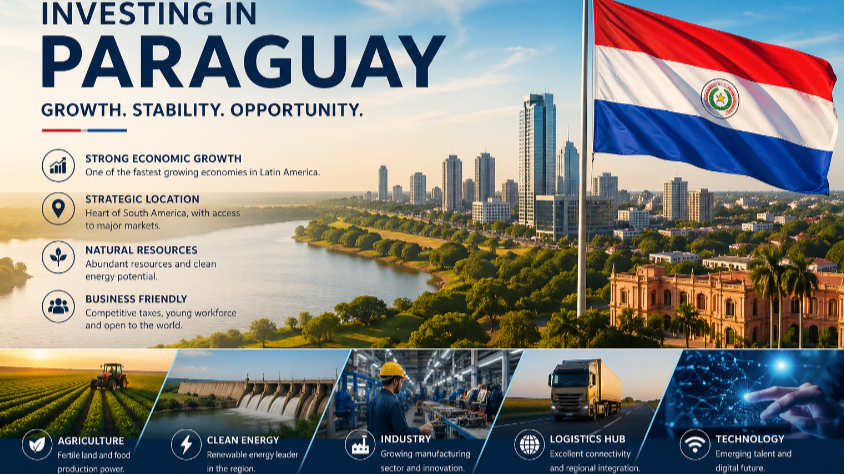
Landlocked yet connected, small yet resilient: Paraguay is building a distinctive investment proposition around energy, logistics, fiscal competitiveness, and access to MERCOSUR.
Carlo Alberto Rovere IMCM, ICWIM
Landlocked yet connected, small yet resilient - Paraguay is quietly building one of Latin America's most compelling investment stories. Here is why the world is paying attention.
4.4% GDP GROWTH 2025 (EST.)
Baa3 MOODY'S INVESTMENT GRADE
The Land Without Evil, and Without Illusions
In Guaraní cosmology, Yvý Maraẽ’ỹ means “the Land Without Evil”, an ancient vision of peace, abundance, and refuge. In modern Paraguay, that idea feels less like mythology and more like a strategic proposition for investors, entrepreneurs, and businesses looking beyond South America’s usual headlines.
At the center of the continent, bordered by Brazil, Argentina, and Bolivia, Paraguay sits at the commercial crossroads of MERCOSUR. Home to roughly 6.4 million people, it has quietly outperformed many regional peers over the past decade, combining steady growth, low taxation, and one of the cleanest energy matrices in the world.
With nominal GDP approaching $45-50 billion, a competitive territorial tax system, and an economy powered almost entirely by hydroelectric renewables, Paraguay has become one of the region’s most underestimated platforms for capital, production, and long-term positioning.
"Surrounded by the region's largest economies, Paraguay serves as a gateway to MERCOSUR markets - an ideal place for competitive production that has been recognized as having the best investment environment in the region."
GEOGRAPHY & CONNECTIVITY
A Landlocked Nation with River Highways
Being landlocked has historically been considered a disadvantage. Paraguay has turned it into a competitive edge. The Paraguay-Paraná Waterway - stretching over 3,400 kilometers - is the country's logistical backbone, carrying 73.9% of its exports by volume. Paraguay boasts the largest river fleet in the region: in 2024, 97% of cargo vessels on the Waterway flew the Paraguayan flag, with more than 3,000 barges operating across 63 ports (15 public, 48 private).
On land, the Bioceanic Corridor is reshaping the continent's trade map. This transcontinental highway will connect Brazil's Atlantic port of Santos to Chile's Pacific ports of Iquique and Antofagasta, crossing straight through the Paraguayan Chaco. When complete, it will dramatically cut transport times to Asian markets for Paraguay and its neighbors - and position Paraguay as the physical link between two oceans.
Paraguay also enjoys preferential treatment within MERCOSUR, with a special rule allowing up to 60% of inputs from third countries in products that still qualify for preferential market access - a competitive edge guaranteed until December 2038
Paraguay's tax code is deceptively simple - and deceptively powerful. While neighboring economies layer businesses with complex corporate tax structures, surcharges, and payroll contributions, Paraguay has built its fiscal framework around a flat, transparent system that consistently ranks as one of the most competitive in the world.
By comparison, corporate tax rates across the region range from 25% (in Bolivia and Uruguay) to 34% in Brazil and 35% in Argentina.
Paraguay's flat 10% rate applies with minimal exceptions, making financial planning transparent and predictable for foreign investors.
The country also maintains a Fiscal Responsibility Law (in force since 2013) that caps expenditure growth, keeping deficits manageable. In 2023, Paraguay's fiscal deficit stood at 4.1% of GDP - a figure that, combined with external debt of about 35.5% of GDP, reflects considerably more room to maneuver than many regional peers.
INVESTMENT RATINGS
Investment Grade, Best Business Climate in South America
In 2024, Moody's upgraded Paraguay's sovereign rating to Baa3 - investment grade - making it one of only a handful of Latin American countries to hold that status alongside Chile, Peru, Uruguay, Mexico, Colombia, and Panama. The upgrade reflected Paraguay's track record of fiscal prudence, exchange rate stability, and institutional independence at the Central Bank.
Early 2025 brought further validation: Standard & Poor's revised Paraguay's outlook from stable to positive, moving the country a step closer to investment grade with that agency as well.
The ranking reflects the confidence of business leaders in economic policy, monetary credibility, and political stability.
ENERGY
The World's Green Energy Powerhouse
In a global economy increasingly scrutinizing supply chains for their carbon footprint, Paraguay holds an extraordinary card: almost all of its electricity is hydroelectric. Two binational plants - Itaipú (shared with Brazil) and Yacyretá (shared with Argentina) - together generate 98.1% of the country's power. Paraguay consumes less than a third of what it produces, exporting 57% of its annual output.
The result is some of the cheapest industrial electricity in Latin America: at roughly $0.04/kWh for low-voltage industrial users - a fraction of what industries pay in Brazil ($0.13/kWh) or Chile ($0.13/kWh). For energy-intensive manufacturing, data centers, or any operation sensitive to energy costs, this differential is transformative.
A 2023 Renewable Energies Law (No. 6,977) has opened the door further, creating a regulatory framework for non-conventional renewable energy generation - solar, wind, and others - with tax incentives for investors and clear licensing pathways for generators who wish to sell surplus power or export it internationally.
PRIORITY SECTORS
Where the Opportunities Are Concentrated
Paraguay's government, through its investment promotion agency REDIEX, has identified a set of priority sectors that combine natural advantage, infrastructure readiness, and incentive frameworks.
Forestry & Timber
Paraguay's vast forest resources offer opportunities in sustainable timber production, paper, and biomass energy. Legal frameworks support reforestation investment.
Green & Organic Production
Growing global demand for sustainably certified products, combined with Paraguay's green energy grid, creates a compelling "clean production" value proposition.
Logistics & Trade
The river fleet, Bioceanic Corridor, and 8 free storage zones in regional ports position Paraguay as an emerging distribution and transshipment hub for South America.
Contact Centers & BPO
A young bilingual workforce (Spanish/Guaraní), competitive labor costs, and growing digital infrastructure make Paraguay attractive for nearshore business services.
Food Manufacturing
Already a top-10 global beef and soy exporter, Paraguay is investing in value-added food processing to move up the supply chain and capture greater margins.
Creative Industries & Tourism
From Jesuit heritage ruins to the Pantanal wetlands, Paraguay's tourism sector remains underexplored - an early mover advantage in hospitality and cultural infrastructure.
HUMAN CAPITAL
A Young, Growing Workforce
Paraguay's demographic profile is one of its most underappreciated assets. With 66.3% of the population between 15 and 64 years old - and a median age well below regional averages - Paraguay is in the midst of a demographic dividend that economists associate with accelerated economic growth, higher savings rates, and rising consumer markets.
The government has invested in linking this workforce to industry needs. The National Professional Promotion Service (SNPP) operates 69 training centers across the country with over 1,000 instructors. Programs range from modular short courses to two-year technical diplomas in industrial electronics, mechatronics, IT programming, and business management. Notably, 70% of dual-training programs take place inside companies, ensuring graduates are job-ready from day one.
Businesses can access recruitment services and a national employment database (PARAEMPLEO) at no cost through the Ministry of Labor - a level of institutional support rarely found in a market of Paraguay's size.
The Time Is Now
Paraguay has never been a country that demands attention. It has earned it through consistency: consistent fiscal discipline, consistent growth above the regional average, and consistent improvement in institutional credibility. For investors tired of volatility, policy reversals, and overexposed markets, that consistency is not a minor advantage. It is the point.
Today, Paraguay combines investment-grade status, a flat 10% corporate tax, one of the cleanest and cheapest energy systems in the region, and a government actively competing for foreign capital through REDIEX. Add to that the Bioceanic Corridor now reshaping regional trade flows, and Paraguay is no longer a frontier market waiting for its turn. It is a market whose moment has already arrived.
And for those thinking beyond capital deployment, there is another advantage most overlook: residency.
Paraguay offers one of the most accessible residency frameworks in South America.
✦ Temporary Residency No minimum investment required. Valid for 2 years and renewable.
✦ Immediate Permanent Residency Available through qualifying investment in one of four categories:
USD 70,000 in a local business
USD 150,000 in the tourism sector
USD 200,000 in real estate
USD 200,000 in financial instruments
For investors, entrepreneurs, and internationally mobile families, Paraguay offers more than market access. It offers optionality: a place to deploy capital, establish legal presence, reduce tax exposure, and build long-term positioning in one of the most overlooked jurisdictions in the Western Hemisphere.
Paraguay does not sell urgency. It offers something rarer: timing, stability, and room to move while others are still looking elsewhere.
Research Sources & Data Integrity
This presentation is built on 32 independent data sources, grouped across public institutions, international bodies, private research, and sector-specific industry references to ensure every figure is grounded in verifiable evidence.
About the Author
Alberto Rovere is an international residency and citizenship strategist with over a decade of experience advising entrepreneurs, investors, and globally mobile families on legal residency, tax positioning, and cross-border structuring.
As Managing Partner of Allie International and co-founder of TaxNomadism™, he works with private clients, family offices, and international intermediaries to design jurisdictional strategies focused on mobility, asset protection, and long-term optionality.
His work focuses on identifying practical pathways for individuals seeking greater flexibility through residency, second citizenship, and international structuring, with a particular focus on Latin America, the Caribbean, and alternative jurisdictions.
For anyone interested in Paraguay residency or international relocation strategies, feel free to DM me.
Disclaimer
This article is provided for informational purposes only and does not constitute legal, tax, investment, or immigration advice. While every effort has been made to ensure accuracy at the time of writing, regulations, investment thresholds, and residency requirements may change without notice and should always be independently verified with qualified local professionals.
Any residency, tax, or investment decision should be assessed based on individual circumstances, objectives, and applicable legal frameworks.